
You have no items in your shopping cart.
Santoku Knives
Translated to mean “three virtues”, Santoku knives are effective all-purpose tools that vary in shape from the western chef knife but serve the same purpose in terms of their utilitarian functionality. The “three virtues” to which the word Santoku refers align with the three tasks of slicing, dicing, and mincing. Their shape is unique to other knives in that Santokus resemble truncated chef knives with altered tips and minimal camber. Unlike the blades of German knives that sweep upwards to meet the tip, the spines of Santokus are rounded downwards to meet the knife edge. Please note that the lack of camber interferes with a traditional rocking motion so Santokus are more often use in a chopping manner.
-

Miyabi Evolution Rocking Santoku
The Evolution 7 in. Rocking Santoku is an amazing knife if you like to "rock" your cuts instead of "chop". The high camber gives less stress to your wrists while cutting with a smooth rocking motion. This 7-inch hollow edge rocking santoku is perfect for all kitchen tasks and rocking cuts. Santoku - Japanese for "three virtues" - excels at three cutting techniques: expertly mince garlic, slice cucumber, and dice onions with this Asian all-rounder. The hollow edge features a blade that has small indentations, known as grantons, that prevent food from sticking while cutting. Crafted from superior quality fine carbide steel that is often used in razor blades, the knives offer the signature sharpness for which Japanese knives are known. A sophisticated six-step ice hardening technique unlocks the steel’s full potential guaranteeing these FRIODUR blades boast remarkable initial sharpness, cutting edge retention, corrosion resistance, and chip-resistant toughness. Beautifully polished to a mirror finish, the blades have a katana edge reminiscent of the samurai swords forged in the same town centuries ago. Curved for comfort and thicker at the end to prevent slipping, the triple-rivet handles encourage fatigue-free cutting. A rounded spine, heel, and bolster, plus nine hand-finishing steps ensure these handles have unsurpassed ergonomics. Learn More$164.95 -

Miyabi Birchwood Bunka Knife
Discover a harmonious blend of traditional Japanese craftsmanship and modern engineering with the Miyabi Birchwood Bunka Knife. This versatile knife is expertly designed for a wide range of kitchen tasks, offering the precision of a Santoku with the added versatility of a classic chef's knife. Its distinctive "K-tip," or reverse tanto, allows for meticulous cuts, making it ideal for everything from fine dicing to intricate garnishing. Handcrafted in Seki, Japan, the epicenter of samurai sword-making, each Miyabi Birchwood Bunka knife is a testament to centuries of artistry and expertise. The blade's stunning Damascus pattern and the unique grain of the Karelian Birch handle make this knife as beautiful as it is functional. It is not merely a tool but a piece of functional art that will elevate your culinary experience. Learn More$364.95 -
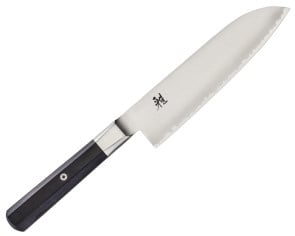
Miyabi Koh 7-Inch Santoku
The Japanese All-Purpose Knife for Everyday Precision
The Miyabi Koh 7-inch Santoku brings Japanese-inspired craftsmanship and versatility to everyday kitchen prep. The Santoku profile is designed for slicing, dicing, and mincing with ease, while its compact, agile shape offers excellent control and precision. From vegetables and herbs to boneless meats and fish, this versatile blade is a dependable choice for a wide range of kitchen tasks. At the heart of the Miyabi Koh series is the revolutionary FC61 fine carbide stainless steel. This advanced alloy solves the age-old kitchen dilemma: it provides the extreme edge retention typically associated with high-carbon Japanese steel while maintaining the chip-resistant toughness of German alloys. Each blade undergoes an innovative FRIODURx2 ice-hardening process, which optimizes the molecular structure of the steel. The result is a staggering 61 Rockwell hardness that remains remarkably resilient under daily professional use. Every Miyabi Koh knife is a tribute to the legendary samurai swords of Seki. Artisans employ a three-step Honbazuke honing process to achieve a scalpel-like 'Katana' edge. The blade’s thin Japanese profile (angled at 9.5–12°) ensures near-zero resistance when slicing through fibrous vegetables or delicate fish. This performance is balanced by an authentic octagonal Pakkawood handle, providing an ergonomic, slip-resistant grip that supports both Western-style chopping and the specialized Asian rocking motion. Finished with a silver mosaic pin, the Miyabi Koh is not just a tool—it is a piece of culinary heritage. Learn More$164.95

