
You have no items in your shopping cart.
Santoku Knives
Translated to mean “three virtues”, Santoku knives are effective all-purpose tools that vary in shape from the western chef knife but serve the same purpose in terms of their utilitarian functionality. The “three virtues” to which the word Santoku refers align with the three tasks of slicing, dicing, and mincing. Their shape is unique to other knives in that Santokus resemble truncated chef knives with altered tips and minimal camber. Unlike the blades of German knives that sweep upwards to meet the tip, the spines of Santokus are rounded downwards to meet the knife edge. Please note that the lack of camber interferes with a traditional rocking motion so Santokus are more often use in a chopping manner.
-
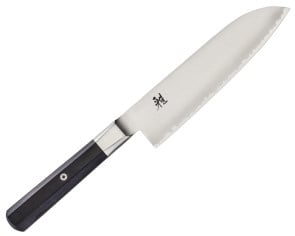
Miyabi Koh 7-Inch Santoku
The Japanese All-Purpose Knife for Everyday Precision
The Miyabi Koh 7-inch Santoku brings Japanese-inspired craftsmanship and versatility to everyday kitchen prep. The Santoku profile is designed for slicing, dicing, and mincing with ease, while its compact, agile shape offers excellent control and precision. From vegetables and herbs to boneless meats and fish, this versatile blade is a dependable choice for a wide range of kitchen tasks. At the heart of the Miyabi Koh series is the revolutionary FC61 fine carbide stainless steel. This advanced alloy solves the age-old kitchen dilemma: it provides the extreme edge retention typically associated with high-carbon Japanese steel while maintaining the chip-resistant toughness of German alloys. Each blade undergoes an innovative FRIODURx2 ice-hardening process, which optimizes the molecular structure of the steel. The result is a staggering 61 Rockwell hardness that remains remarkably resilient under daily professional use. Every Miyabi Koh knife is a tribute to the legendary samurai swords of Seki. Artisans employ a three-step Honbazuke honing process to achieve a scalpel-like 'Katana' edge. The blade’s thin Japanese profile (angled at 9.5–12°) ensures near-zero resistance when slicing through fibrous vegetables or delicate fish. This performance is balanced by an authentic octagonal Pakkawood handle, providing an ergonomic, slip-resistant grip that supports both Western-style chopping and the specialized Asian rocking motion. Finished with a silver mosaic pin, the Miyabi Koh is not just a tool—it is a piece of culinary heritage. Learn More$164.95 -
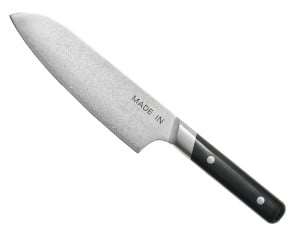
Made In 6.6-inch Japanese Damascus Steel Santoku
The Made In Japanese Damascus Steel Santoku is a compact all-purpose knife for cooks who want Japanese precision in a shorter, easier-to-control blade. Its name means “three virtues” for the three jobs it handles: slicing, dicing, and mincing. Made In has it forged in Seki, Japan, with a VG-10 core inside 66 layers of Damascus steel and a 15-degree edge.
Why It PerformsFlat edge, rounded tip: The flatter profile meets the board along its whole length, which suits a forward push cut rather than a rocking motion.Compact blade: At 6.6 inches, it is easier to control than a full chef’s knife, especially in a smaller kitchen or for cooks with smaller hands.VG-10 core and Damascus cladding: A hard stainless core for a keen, long-lasting edge, protected by layered steel with a distinctive pattern.15-degree edge: Cuts with little resistance through vegetables, boneless meat, and fish.Full tang, polymer handle: Balanced in the hand, with a hand-finished handle that resists slipping and staining.
What It Does BestDicing and slicing vegetables with a push cutSlicing boneless chicken, pork, and fishMincing herbs and garlicEveryday prep for one or two people
Choosing the Right Made In KnifeFor larger tasks and a longer slicing stroke, the Made In 8-inch Japanese Damascus Steel Gyuto gives you 8.2 inches of blade. For vegetable-heavy cooking, the Made In 6.6-inch Japanese Damascus Steel Nakiri has a taller, fully flat edge. The santoku, gyuto, and nakiri are sold together in the Made In 3-Piece Japanese Damascus Steel Knife Set. Learn More$199.00 -

Zwilling Spectrum 5.5 in Prep Knife
The Zwilling Spectrum 5.5-inch Prep Knife is a versatile and agile tool, expertly designed to bridge the gap between a paring knife and a full-sized chef's knife. Its compact blade is perfect for those in-between tasks where precision is key, such as mincing shallots, slicing herbs, or cutting citrus. This German-made knife is an indispensable addition for any home cook seeking effortless control and lasting sharpness. Engineered for comfort and safety, the knife features an innovative curved bolster that acts as a natural extension of your hand. This design encourages the professional "pinch grip," allowing for finer control and reducing strain during intricate tasks. The full tang construction is perfectly balanced by a stainless-steel endcap, providing a feeling of stability and agility as you work. The handle is crafted from Jute Micarta, a durable composite material with a distinctive, textured lattice pattern. This streamlined, ergonomic shape ensures a secure, non-slip grip for confident handling, even with wet hands. The moisture-resistant properties of the handle guarantee longevity and a comfortable feel with every use. Learn More$169.95 -

Kikuichi Warikomi Damascus Tsuchime Santoku
A fresh take on the WGAD series, now featuring a stunning Birch handle. The WDT series is a refined counterpart to the WG series, showcasing the same warm Birch handle paired with a meticulously crafted 17-layer hammered VG10 blade. This exceptional knife stands out both on the cutting board and in the knife block. With a weight comparable to many German knives, the WDT series is a favorite among those who appreciate the fusion of a Western-style handle with a precision Japanese blade. The VG10 edge is renowned for its fine grain structure and outstanding durability, while the hammered tsuchime finish enhances food release. Each knife is hand-engraved with the signature Kikuichi chrysanthemum logo. Learn More$309.95 -

Kikuichi Molybdenum Santoku
The Kikuichi Moly Pro series is so named because it has a higher content of Molybdenum steel providing a razor sharp edge. This santoku is excellent for vegetable prep and for slicing meat that have already been removed from the bone.
Made in: Nara, Japan Learn More$189.95 -

Kikuichi GC Series Carbon Steel 7.1-inch (180mm) Santoku (SC18)
Kikuichi’s SC18 is the santoku of its GC Series carbon steel line, a 7.1-inch (180mm) blade with the flatter edge and rounded tip that suit push cuts and fine dicing. Kikuichi describes the series as sharp, light and tough, and shoppers find this knife by its model number.A santoku is a natural fit for cooks who chop straight down and forward without rocking the knife, and its broad blade scoops ingredients from the board. The carbon steel takes a keen edge and is easy to bring back on a whetstone. It will form a patina, and it needs wiping dry during prep, especially after cutting tomatoes or citrus. It makes a practical single knife for a home cook who mostly prepares vegetables.
Santoku or Gyuto?The 7.1-inch (180mm) Gyuto is the same length with a pointed tip and more curve for rocking cuts. For a longer all-purpose knife, see the 8.25-inch (210mm) Gyuto. Learn More$134.95 -

F. Dick Premier Plus 5.5 in. Granton Edge Santoku
This unique little Santoku by Friedrich Dick is an amazing addition to a home kitchen or chef's tool roll. This knife is small enough at 5.5 in. (140mm) to be a nimble utility knife but broad enough for a person with smaller hands to use this as an everyday vegetable knife. The Granton or Kullenschliff (in German) Edge is what really makes this knife special as many smaller blades don't have a hollow edge cut in. The Granton edge will help keep food like onion or tomato from clinging to the blade allowing for a quicker prepping experience. Made in Germany. Learn More$78.65 -
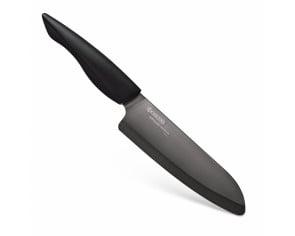
Kyocera Innovation Black 6-inch Ceramic Chef's Santoku (ZK-160 BK)
Kyocera calls this shape a chef’s santoku. It has the flat edge of a santoku and a 6-inch blade, enough length for chopping a head of broccoli or slicing a cucumber end to end on a full-size board.Kyocera lists chopping, slicing, dicing and mincing among its jobs, and the ceramic blade earns its keep on fruit and vegetables. It cannot rust and does not react with acidic ingredients. In Kyocera’s paper-cutting tests, Innovation blades lasted twice as long before dulling as the brand’s traditional ceramic. Since ceramic chips under twisting or impact, keep a steel knife nearby for bones, frozen food and hard cheese.Knife Merchant sells Kyocera as an authorized dealer, which customers ask about before buying. The answer affects coverage, since Kyocera’s limited warranty excludes knives sold by unauthorized dealers.
Chef’s Santoku or Chef’s Knife?The Innovation Black 7-inch Chef’s Knife adds an inch and a pointed tip. For a smaller hand or a short prep list, the 5.5-inch Innovation Black Santoku is easier to manage. It is also the larger of the two knives in the Innovation Black 2-Piece Ceramic Knife Set. Learn More -

Kyocera Innovation Black 5.5-inch Ceramic Santoku (ZK-140 BK)
At 5.5 inches, this is the smaller of the two Innovation Black santoku knives we carry, sized for preparing a few vegetables at a time with close control. The flat edge suits push cuts, so slicing scallions, dicing an onion and mincing parsley all happen with a straight down-and-forward stroke.Kyocera’s figures show this ceramic holding its sharpness twice as long as the company’s older Z206 material. The blade will not brown a cut apple or pick up a metallic taste from vinegar, and it cannot rust. Ceramic is also brittle, which is why Kyocera recommends steel for boning and frozen food.Customers ask us how to sharpen a ceramic santoku. A honing rod will not restore this edge, and Kyocera specifies diamond for the job. The Kyocera Diamond Wheel Sharpener is the home option. For a worn edge or a chipped tip, Kyocera sends owners to EVERSHARP, its authorized service provider (details on Kyocera’s sharpening service page).
5.5-Inch or 6-Inch Santoku?The Innovation Black 6-inch Chef’s Santoku gives a little more length for larger vegetables and a full cutting board. The same knife comes in the 4-Piece Set. With a white blade, it is the Innovation White 5.5-inch Santoku. Learn More$80.00 -

Miyabi Birchwood Rocking Santoku
The Miyabi Birchwood 7 in. (180mm) Rocking Santoku is a modern Japanese knife for chopping, mincing and slicing vegetables. The special feature of the Rocking Santoku is its thin blade with a kiritsuke shaped edge. Extremely versatile, can even be used for decorating purposes. This 7-inch rocking santoku is perfect for all cutting tasks, including rocking cuts. Santoku - Japanese for "three virtues" - excels at three cutting techniques: expertly mince garlic, slice cucumber, and dice onions with this Asian-style all-rounder. Handcrafted in Seki, Japan, top-of-the-line MIYABI Birchwood is a work of culinary art. Both blade and handle are crafted from the most precious materials, which shape their striking appearance. More than meets the eye, the potent core of SG2 micro-carbide powder steel is protected by a stunning 100-layer flower Damascus pattern. MIYABI’s innovative, CRYODUR ice-hardening process locks in the blade’s long-lasting sharpness. The blades are Cryodur ice-hardened for enhanced hardness, flexibility and are corrosion resistant. Each knife is hand-finished in the Honbazuke 3-step method, creating a beautiful mirror polished edge. A Katana edge is featured on each knife blade, reminiscent of the legendary Japanese swords, known for superb craftsmanship. The blade is adorned with a Birchwood traditional D-shaped style handle with an intricate mosaic pin, accented with two red spacers and stainless engraved end cap. A prized material for knife handles, Karelian Birch is also the only wood ever used in a Faberge egg. Handcrafted in Seki, Japan with a lifetime warranty. Learn More$364.95

