
You have no items in your shopping cart.
Gyuto
Although not a traditional Japanese knife shape, a gyuto is considered to be the Japanese alternative to a chef knife. Much flatter along the blade and longer in the heel, Gyutos lack the camber of a traditional chef knife. If you are unsure of whether a knife is a chef knife or a Gyuto take a look at the tip; on a Gyuto the tip will be parallel to or below center line of the knife.
-

Kikuichi Kokaji White Carbon 8.25-inch (210mm) Kiritsuke Gyuto
Sakai’s Kokaji-kai smiths hand forge the Kokaji kiritsuke gyuto, which pairs a White #2 carbon edge with the angled kiritsuke tip of the traditional Japanese knife. Each blade carries a hand-engraved chrysanthemum.Kikuichi gives the Kokaji gyuto a double-bevel, 50/50 edge, so it works like a chef’s knife for left- and right-handed cooks, and the angled tip adds precision for fine cuts and scoring. The 8.25-inch (210mm) length handles everyday prep, from dicing onions to slicing proteins. Hardened to 61 to 62 HRC, the steel takes a very keen edge and will patina with use, so it suits a cook who already cares for carbon steel. A saya is included, and the knife should be sharpened on whetstones to keep its double bevel even.
Comparing Carbon GyutosFor a Western-handled carbon gyuto, see the GC Series Carbon Steel 8.25-inch (210mm) Gyuto. The Kokaji 9.4-inch (240mm) Kiritsuke Yanagi is the single-bevel slicer of the line. Learn More$479.95 -

F. Dick Eurasia 8-inch Gyuto
The Eurasia gyuto borrows the shape of a Japanese chef’s knife and adds a slimmer profile, good knuckle clearance and no full bolster. It is an all-purpose kitchen knife for cooks who like a pinch grip.Without a heavy bolster, the hand can choke up on the blade for control, and the full edge reaches the board and sharpens evenly from heel to tip. The tapered edge is easy to hone and resharpen on a stone or a ceramic rod. The handle is sealed to the blade with no gap that could open with use.For a cook moving from a heavier forged chef’s knife, it feels lighter at the front and quicker on the board.A shorter, nimbler version is the Eurasia 7-inch gyuto. For a conventional chef’s knife, the Premier Plus 8-inch chef’s knife has a heavier blade. Our kitchen knife shapes guide compares gyuto and chef’s knives. Learn More$91.00 -

Shun Classic 7-inch Asian Cook's Knife
The Shun Classic 7-inch Asian Cook’s Knife is a gyuto, the Japanese counterpart to the Western chef’s knife. Like any chef’s knife, it is an all-purpose blade: it excels with meat and fish and performs equally well on vegetables. Its profile is narrower than a traditional chef’s knife, which makes it lighter and more nimble, yet it still leaves enough height for knuckle clearance on the board. It suits cooks who find a full-size chef’s knife heavy and want one agile knife for most of their prep.
FeaturesNarrow gyuto profile: The slimmer blade is lighter and quicker in hand than a traditional chef’s knife while still clearing the knuckles.VG-MAX cutting core: Shun’s proprietary steel is strong, fine-grained, and resistant to wear and corrosion, and it holds a very keen edge through extended prep.Stainless Damascus cladding: Layered stainless steel supports the core, adds stain resistance, and helps food release from the blade.Hand-sharpened double-bevel edge: The fine, symmetrical edge serves left- and right-handed cooks equally well.D-shaped ebony PakkaWood handle: The handle is comfortable in either hand, durable enough for daily use, and does not harbor bacteria.Full composite tang: The composite construction keeps the knife light and balanced.Handcrafted in Seki City, Japan: Each Shun Classic knife requires at least 100 individual steps to complete in Seki City, one of Japan’s most important blade-making centers since the 13th century.Free lifetime sharpening: Shun offers free lifetime sharpening, so the knife can be professionally sharpened by the manufacturer whenever its edge needs restoring.
Tasks It Handles WellSlicing and portioning boneless meatsCutting fish fillets into portionsSlicing and dicing vegetablesSlicing fruit and cheese
Choosing a Shun Chef’s KnifeFor a wider blade with a more pronounced curve for rocking cuts, the Shun Classic 8-inch Chef’s Knife is the traditional Western choice. Cooks who want an even more compact chef’s profile should compare the Shun Classic 6-inch Chef’s Knife. Learn More$179.95 -
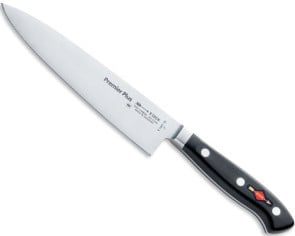
F. Dick Eurasia 7-inch Gyuto
A thinner profile than other F. Dick forged knives makes this 7-inch Eurasia gyuto a nimble blade for fine cuts such as julienne and dicing, and it handles fish well. The reduced bolster suits a cook with a good pinch grip.The shorter length gives close control near the tip, which helps with brunoise and with slicing fish for plating. The blade is forged and balanced, with a well-proportioned handle sealed to the steel for hygiene. It is a good choice for smaller hands or a small cutting board.It also slices raw fish for sashimi and crudo with clean faces, and it trims a chicken breast neatly. A cook who prefers a lighter knife may find it easier to use for long prep sessions than an 8-inch blade, and it fits a small knife roll.For more length, the Eurasia 8-inch gyuto is the all-purpose size. A vegetable-focused alternative is the Eurasia 7-inch granton edge santoku, and the comparison table below lists the full Eurasia range. Learn More$79.95 -

Glestain KE Series 8.3-inch (210mm) Left-Handed Gyuto
The 210mm Left-Handed Gyuto is Glestain’s everyday chef’s knife made for the left hand. Its blade is a mirror image of the right-handed 721TK, with the steep face and the dimples on the opposite side, so slices fall away and the knife holds its line when a left-handed cook pushes it through an onion or a stack of peppers.At 210mm it suits a standard home board as well as a station in a professional kitchen. The KE Series bolster and end cap make it a solid, hand-balanced knife; cooks who want something lighter at this length can choose the K Series model, which drops the end cap. The way that food doesn’t cling to the blade really speeds up dicing potatoes, onions and the like. Everything just stays on the cutting board without having to hold the slices together. If you do a lot of cutting, this is likely to become your favorite knife.Left-handed Japanese knives are hard to find, and an asymmetrical blade cannot be reground for the other hand. Buying the left-handed model is the only way to get the Glestain geometry working in the left hand.
Other Left-Handed Glestain KnivesSee the K Series 210mm Left-Handed Gyuto for a lighter knife and the 240mm Left-Handed Gyuto for more length. The left-handed range also includes the 170mm Left-Handed Santoku and the 140mm Left-Handed Utility Knife. Our guide to knife shapes explains how these knives differ. Learn More -

Glestain KE Series 11.8-inch (300mm) Gyuto
The Glestain 11.8 in. (300mm) Gyuto is an excellent knife for heavy use. The way that food doesn't cling to the blade really speeds up dicing potatoes, onions, etc.. Everything just stays on the cutting board without having to hold the slices together. If you do a lot of cutting, this is likely to become your favorite knife. Learn More$319.00 -

Glestain KE Series 10.6-inch (270mm) Gyuto
The Glestain 10.6 in. (270mm) Gyuto is an excellent knife for heavy use. The way that food doesn't cling to the blade really speeds up dicing potatoes, onions, etc.. Everything just stays on the cutting board without having to hold the slices together. If you do a lot of cutting, this is likely to become your favorite knife. Learn More$269.00 -

Glestain KE Series 9.4-inch (240mm) Gyuto
The 240mm KE Series gyuto is the Glestain chef’s knife for long sessions at the board. Its blade is long enough to slice across a cabbage or a boneless pork loin in one stroke, and the bolster and stainless end cap make it one of the heftiest knives in the line, so the weight of the knife does part of the work on dense produce.Two features set every Glestain apart from a conventional chef’s knife. The deep dimples on the face of the blade break the suction that holds slices of potato, apple or cucumber against the steel, so cut food falls away and you spend less time clearing the blade. The blade is also asymmetrical, shaped more like a right triangle than an even wedge, which pushes each slice away from the knife as it cuts.Both home cooks and professional kitchens buy this knife from us, and Glestain knives are seldom returned. In our experience the end cap’s added weight suits a 240mm blade well, balancing the extra length toward the hand.The steel holds an edge well and is easy to maintain. It isn’t brittle and can be quickly brought back with a honing rod. This knife improves the quality and consistency of your cuts. It produces clean, repeatable results with less effort, which becomes clear with regular use. If you are actively developing your technique, it is still important to practice with other knives as well, so you don’t develop bad habits.
Other Lengths and HandlesThe same blade without the end cap is a lighter knife; see the SO Series 240mm Gyuto, which has no bolster at all, or the all-metal Ice Handle 240mm Gyuto. For a shorter knife, the KE Series 210mm Gyuto is the same design. Left-handed cooks should choose the 240mm Left-Handed Gyuto. Our guide to kitchen knife shapes explains how a gyuto compares with a santoku and other chef’s knives. Learn More$231.00 -

Glestain KE Series 8.3-inch (210mm) Gyuto
A 210mm gyuto is the length that fits a home cutting board and a crowded line station alike. This KE Series model gives that length the full Glestain treatment, with a bolster and a stainless end cap that add weight at the back of the handle.On the board, the dimpled face is what you notice first. Diced potato, sliced zucchini and rounds of carrot drop away from the blade instead of riding up it, so the knife stays clear between strokes. The asymmetrical grind pushes each slice off the blade, which makes fast, repetitive cuts cleaner and more consistent.The 210mm gyuto is the most popular size for home and line cook use. Fast, efficient and resilient, this knife holds up to tough use. The end cap is a matter of preference at this length. It moves the balance toward the hand, which some cooks like for control during fine work. Others prefer the lighter, slightly blade-forward feel of the K Series knife, which has the same blade without the cap.
Choosing a 210mm GlestainCompare this knife with the K Series 210mm Gyuto (bolster, no end cap), the SO Series 210mm Gyuto (no bolster) and the Ice Handle 210mm Gyuto (stainless handle). Left-handed cooks can choose the KE Series 210mm Left-Handed Gyuto. For a longer blade, see the KE Series 240mm Gyuto, and for help with chef’s knife shapes, see our kitchen knife shapes guide. Learn More$193.00 -

Glestain K Series 8.3-inch (210mm) Gyuto
The K Series 210mm gyuto has the same blade as the KE Series 721TK without the stainless end cap. Removing the cap makes the knife lighter and moves the balance toward the blade, and it is the less expensive way to own a 210mm Glestain.I actually prefer a knife to be a bit blade heavy. While many chefs consider the balance of a knife in their hand, I prefer to think of it as how the knife feels when I’m cutting. A slightly blade heavy knife feels perfectly balanced when I start applying pressure to the food being cut. Since I can’t juggle, and this isn’t a throwing knife, the balance in my hand means very little to me, and I prefer this knife.The dimples release slices of onion, potato and cucumber, and the asymmetrical grind keeps each cut moving cleanly into the next.This is a knife that suits home cooks and line cooks equally, and one that rarely comes back to us after purchase.
Choosing a 210mm GlestainFor more heft at the hand, choose the KE Series 210mm Gyuto. The SO Series 210mm Gyuto is lighter still, with no bolster, and the Ice Handle 210mm Gyuto has a stainless handle. Left-handed cooks can choose the K Series 210mm Left-Handed Gyuto. See our guide to kitchen knife shapes for more on the gyuto. Learn More$181.00

