
You have no items in your shopping cart.
Carving Forks
Carving forks come in two forms: straight and curved. Straight forks are the predecessor to tongs and are typically used for maneuvering meats in a sauté pan or piercing and bleeding cuts that are cooked to a higher level of doneness. Curved forks are useful in that the tines never interfere with cutting and are otherwise ideal when used as a pot fork to lift turkeys, casseroles, etc. from the oven.
-
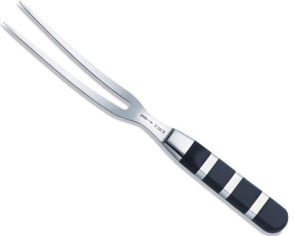
F. Dick 1905 8 in. Carving Fork
Lock in Every Slice with Forged 1905 Precision When you anchor the F. Dick 1905 8-inch Carving Fork into a prime rib or Thanksgiving turkey, the first thing you notice is the lack of lateral flex. Unlike stamped consumer forks that yield under pressure, this tool is fully forged, providing a rigid spine that transmits clear tactile feedback through the handle to your palm. You can feel exactly when the tines have cleared the bone, ensuring your slicing path is never obstructed. The 1905 Series is a modern tribute to the original Friedrich Dick design, replacing traditional rivets with solid steel rings fused to the high-quality Polyoxymethylene (POM) handle. This isn't just an aesthetic choice; the weight distribution moves slightly toward the hand, offering a balanced counterweight to the 200mm tines. During long service sessions at a carving station, this balance reduces wrist strain significantly. The steel itself is X50CrMoV15, an alloy chosen for its corrosion resistance and structural integrity. At a Rockwell hardness of 56 HRC, the tines are tough enough to resist bending even when prying against heavy joints, yet they retain a polished finish that glides through muscle fibers without tearing. The transition from the tines to the handle is seamless and hygienically sealed, leaving no microscopic gaps for grease or protein to hide, meeting the strictest sanitary standards for professional kitchens. Learn More$105.95