
You have no items in your shopping cart.
Butcher / Breaking
Primarily used for processing large cuts of meat, butcher and breaking knives are essential tools for professional chefs and cooking enthusiasts alike. With blades typically ranging from 8 to 12 inches in length butcher and breaking knives are often thought of interchangeably however there are definite distinctions in form that enable each to excel at different tasks. Butcher knives have long, stiff blades that come to a clubbed end which is ideal for holding a straight line while portioning steaks and trimming fats from primal cuts. Breaking knives are thinner and more flexible than butcher knives with tips that curve upwards towards the spine of the blade. Breaking knives are designed for use on primal cuts out of a hanging side of beef and are also extremely functional when breaking down whole fish. Scimitars (sometimes spelled Cimiters) are commonly categorized along with breaking and butcher knives as well. Similar to butcher knives in thickness, scimitars are wide and stiff with an upward curvature. This curved shape is beneficial in that it creates a longer slicing area which allows for a greater range per single slicing motion.
-
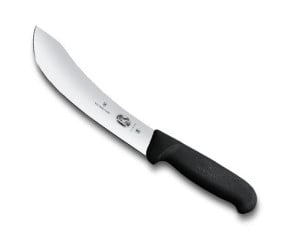
Victorinox Fibrox Pro 6 in. Western Beef Skinner
The Victorinox Fibrox Pro 6 in. Western Beef Skinner is built for precision, control, and efficiency when processing large game. Designed with a curved, razor-sharp blade, it glides cleanly between hide and muscle, making it ideal for beef, elk, and other big-game animals. The high-carbon stainless steel edge holds its sharpness exceptionally well, while the ergonomic Fibrox Pro handle ensures a secure, slip-resistant grip—even in wet conditions. Durable, reliable, and trusted by butchers and hunters alike, this skinner is a must-have tool for clean, confident field or shop work. Learn More$48.00 -

Victorinox Fibrox Pro 5 in. Beef Skinning Knife
The Victorinox Fibrox Pro 5 in. Beef Skinner is built for precision, control, and efficiency when processing large game. Designed with a curved, razor-sharp blade, it glides cleanly between hide and muscle, making it ideal for beef, elk, and other big-game animals. The high-carbon stainless steel edge holds its sharpness exceptionally well, while the ergonomic Fibrox Pro handle ensures a secure, slip-resistant grip—even in wet conditions. Durable, reliable, and trusted by butchers and hunters alike, this skinner is a must-have tool for clean, confident field or shop work. Learn More$44.00 -
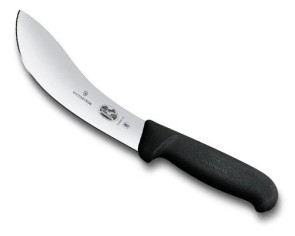
Victorinox Fibrox Pro 6 in. Skinning Knife
Fibrox handle provides a firm grip, and wide upswept tip easily loosens hides on sheep, goats, deer and elk. Learn More$48.00 -
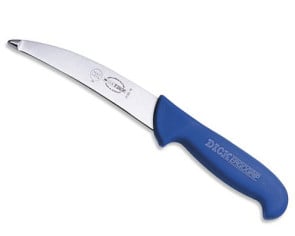
F. Dick Gut and Tripe Knife
F. Dick 6 in. Gutting Knife a special knife that has two sharp blade sides and a metal ball at the tip. It is used to cut open the abdominal wall of cattle. To do so, it is cut with the knife tip on the cutting side of the special knife. The abdominal wall is then cut open completely with the hook-shaped end of the blade spine. The ball at the tip prevents internal organs from being damaged. The special (Cattle) knife plays an important role in the knife assortment of professional slaughterhouses and also in home slaughter. The main feature of its handling is its precise cutting action, which ensures that the thin intestinal wall is not damaged. This is why it needs its special shape, the basis of which is easy handling. Damage to the internal organs would significantly reduce the quality and financial value of the meat products. Its distinctive feature is its double cutting edge and the metal ball on the tip. Learn More$31.85 -
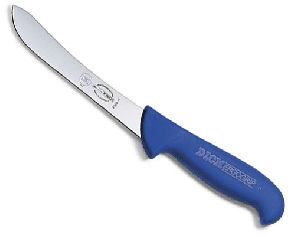
F. Dick ErgorGrip 6 in. Trimming Knife
F. Dick 6 in. (150 mm) Trimming Knife used in meat and fish processing for a variety of task. From trimming fat to skinning and removing silver skin this knife can fill a lot of rolls in the kitchen. A fair amount of flex and high quality German Steel will allow the knife to retain its edge well, while also being stainless. The trimming knife is used to separate pieces of meat from fat, tendons and skin. That is why the trimming knife also belongs to the butcher's knife family. The blade is slightly curved upwards, becoming slightly wider in the front area than in the middle. This gives it more surface area, allowing you to make a long, pulling cut. Like the classic butcher's knife, it is also used to cut larger pieces of meat. This makes the trimming knife one of the most versatile butcher’s knives in slaughterhouses and cutting plants. The purpose of the trimming knife is to produce beautiful pieces of meat that have been cleanly separated from components such as tendons and fibres and can then be processed further without any problems. The subsequent process of portioning, or cutting the meat into ready-to-eat pieces, also requires precision and exact cutting. That is why it is important that you have a sharp trimming knife in your hands so that you can cut the meat cleanly and create a beautiful cut pattern. A trimming knife is distinguished first and foremost by its blade shape. It is on the narrow side, curved upwards and ends in a wide, rounded blade tip. This simplifies handling and allows the knife to glide along easily when cutting. This means that the cuts are long and can be made in a flowing movement, while the more comfortable hand position is easy on the wrist. Learn More$23.40