
You have no items in your shopping cart.
Wusthof Classic Knives
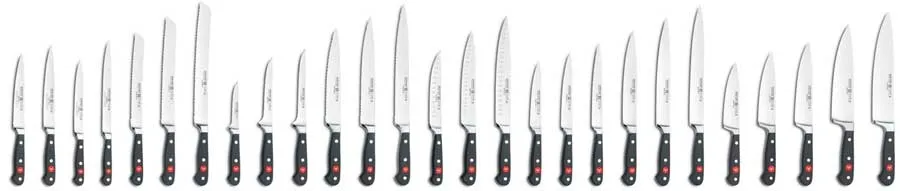
Wusthof Classic series has the most robust offering of all the Wusthof product lines. Meaning that there are many specialized tools available in this series. So if you like all of your tools to match, Wusthof Classic is an excellent choice. The knives are very consistently crafted with a smooth polish and nice taper from the handle to the tip, and spine to edge. Tempered to a Rockwell hardness of 58, they are easily maintained with the use of a honing rod. Edges are set via precise laser-guided technology. Full bolster, full tang, hot forged, with triple riveted handles of polyoxymethylene. Made in Solingen, Germany, Wusthof Classic knives are backed by a lifetime warranty.
-

Wüsthof Classic 2.75-inch Peeling Knife (Bird's Beak)
Many cooks know Wüsthof’s Classic peeling knife as a bird’s beak. Its short blade that curves down to its point. The curve follows the shape of round fruit and vegetables, so it peels an apple, a pear or a turnip in one continuous strip and cuts close to the skin.Classically trained cooks use it for tourné cuts, the seven-sided barrel shapes carved from potatoes and carrots. It also removes the eyes and blemishes from potatoes, cuts citrus zest into fine strips and shapes radish and mushroom garnishes. The 2.75-inch blade keeps your hand close to the work for control.A peeling knife is a specialist; it does not slice on the board as well as a straight paring knife. Pair it with the Classic 3.5-inch paring knife for everyday trimming, or the Classic Ikon 3-inch flat cut paring knife for straight cuts. The table below compares all of Wüsthof’s small blades, and our kitchen knife shapes guide explains the bird’s beak shape. Learn More$94.95 -

Wüsthof Classic 3.5-inch Paring Knife
A paring knife handles the small, close work a chef’s knife is too large for, and the Wüsthof Classic 3.5-inch is the size we reach for first. Its narrow, pointed blade hulls strawberries, trims the root end of a shallot, deveins shrimp and cuts the core from a halved apple.Much of that work happens in the hand, off the board, so control matters more than length here. The short blade keeps the tip close to your fingers. Its three-rivet handle gives a secure hold when your hands are wet from washing produce. On the board, the tip scores the skin of a duck breast or a loaf of bread before baking.For a slightly longer blade that also slices small fruit on the board, see the Classic 4-inch paring knife. For peeling round fruit and shaping garnishes, the curved Classic peeling knife is the better tool. The Classic Ikon 3.5-inch puts this blade on Ikon’s rounded handle, and our kitchen knife shapes guide compares the paring styles. Learn More$94.95 -

Wüsthof Classic 4-inch Paring Knife
Half an inch longer than the standard paring blade, the Wüsthof Classic 4-inch paring knife adds reach, and that extra length lets it work on the cutting board as well as in the hand. It slices limes for drinks, segments an orange and trims the fat cap from a small steak.The pointed tip still handles detail work, such as removing the eyes from a potato or hulling berries, and the blade is long enough to cut a whole apple into wedges without sawing. Its grip holds firm even with damp fingers, and the knife is light enough to use for a long session of prep.Choose the Classic 3.5-inch paring knife if your paring is done in the hand, and this 4-inch if you also want a small knife for quick jobs on the board. For jobs between paring and chef’s knife, see the Classic 4.5-inch utility knife. Our guide to knife shapes explains where paring and utility knives overlap. Learn More$94.95 -

Wüsthof Classic 4.5-inch Utility Knife
Wüsthof calls this knife a utility knife, and the name fits its job. The Classic 4.5-inch fills the space between a paring knife and a chef’s knife, with a blade long enough to slice a tomato or cut a block of cheese, and narrow enough to trim a pork tenderloin or peel a mango.Some cooks know this size as a petty knife, the Japanese term for a small all-purpose blade. It is a sensible second knife for a kitchen that already has an 8-inch chef’s knife, since it handles the small jobs that make a big knife feel clumsy. It also trims meat, deveins shrimp, removes small bones from seafood, sections citrus and makes quick work of lunches and snacks. For a cook who wants to keep the collection small, it is a good two-for-one.Classic is the original Wüsthof line, with the widest variety of shapes and styles. For longer slicing, see the Classic 6-inch utility knife; for a wider blade that also chops herbs and garlic, the Classic 4.5-inch Asian utility knife. The Classic Ikon 4.5-inch utility knife has this length on the contoured Ikon handle. See our Kitchen Knife Shapes guide for more on utility knives. Learn More$94.95

