
You have no items in your shopping cart.
Wusthof Classic Knives
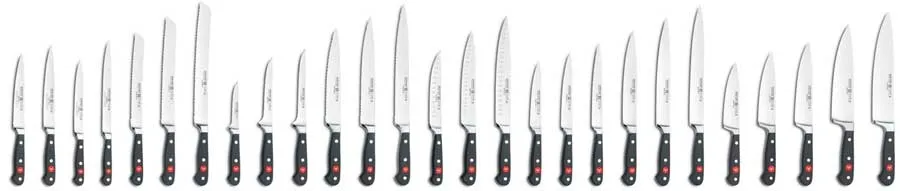
Wusthof Classic series has the most robust offering of all the Wusthof product lines. Meaning that there are many specialized tools available in this series. So if you like all of your tools to match, Wusthof Classic is an excellent choice. The knives are very consistently crafted with a smooth polish and nice taper from the handle to the tip, and spine to edge. Tempered to a Rockwell hardness of 58, they are easily maintained with the use of a honing rod. Edges are set via precise laser-guided technology. Full bolster, full tang, hot forged, with triple riveted handles of polyoxymethylene. Made in Solingen, Germany, Wusthof Classic knives are backed by a lifetime warranty.
-

Wüsthof Classic 5-inch Hollow Edge Santoku
The Wüsthof Classic 5-inch hollow edge santoku is a compact Japanese-style knife for everyday vegetables. Its short, wide blade dices an onion and minces garlic, and the flat profile suits a straight up-and-down cut. It is also a good alternative to a utility knife; the blade is taller, which leaves more room between your hand and the board and makes chopping more comfortable.A row of oval hollows along the blade traps a thin layer of air between steel and food, so slices of potato drop off the blade cleanly. Wüsthof grinds its santokus to a finer angle than its chef’s knives, which suits thin, precise slicing.At 5 inches, it suits a compact cutting board and anyone who wants a second knife for quick jobs, and its short blade is easy to control as you build speed with knife skills. It is also a good knife to have on hand when children like to help in the kitchen. It also makes a good gift, since the size and shape are unusual enough that the recipient is unlikely to own one already. Rinse and dry it after cutting acidic foods such as tomatoes. For more length, the Classic 7-inch hollow edge santoku handles larger produce, and the Classic Ikon 5-inch santoku is the contoured-handle alternative. Our kitchen knife shapes guide explains how a santoku differs from a chef’s knife. Learn More$149.95

