
You have no items in your shopping cart.
Minonokuni Knives
Authentic Japanese blades (hochoes) hand-forged using traditional Japanese methods of old-world craftsmanship; Minonokuni knives are part of a project designed to preserve and protect the master/apprentice relationship. Even as demand for Japanese knives has grown; the skilled masters are aging, and it has been difficult to keep apprentices. While the methods of construction mastered over the centuries have changed very little, the methods of bringing the pieces to market is dramatically different. Then Knife Merchant was asked to assist by bringing knives from various masters in different types of material to market, so that the craftsmen can concentrate on their work and keep the apprentice fully employed, without the burden of stopping production to make sales. Minonokuni is the name of a prefecture (state) that existed in the days of the Samurai. It encompassed a wide area including Seki-City and Sakai, which are the areas of Japan in which our craftsmen are making these blades. This is why we have chosen this as a brand name to represent these knives. You will find the quality to be far superior to comparable material types. When the knife maker has his name on the blade (instead of working for a company), there is greater pride and care taken in little details that make a great difference in final quality. Minonokuni knives are now available in a variety of grades to suit every need and price point.
-

Minonokuni Raku Super Tsuchime 7.1-inch (180mm) Gyuto
In Japanese, raku means both being happy and being easy, and the Raku series is named for a cook who works happily with a knife that is sharp and easy to maintain. This 180mm gyuto is an all-purpose knife that handles everything from filleting fish to chopping a bushel of carrots.The blade is forged from Aogami Super, a blue steel known for holding a fine edge, and it responds well to waterstones and ceramic rods when it does need attention. The hammered tsuchime finish on the blade face gives each knife its own texture.
Raku Among Our Blue Steel GyutoA hand-forged gyuto of this compact size is uncommon. Raku suits a cook who sharpens on stones and is comfortable caring for carbon steel. For blue steel with a stainless jacket and less upkeep, see the Homura 210mm gyuto. The Aogami Black 180mm gyuto and Aogami Damascus 180mm gyuto are the other 180mm choices.Longer Raku gyuto are the 210mm and 240mm. Our knife shapes guide covers the gyuto. Learn More -

Minonokuni Raku Super Tsuchime 6.7-inch (170mm) Santoku
The Raku 170mm santoku is a very versatile knife with a flatter edge than a gyuto. It suits a cook who works on a smaller board and prefers push cuts and tap chopping, and it handles vegetables, boneless meat and fish with equal ease.Its hammered tsuchime finish gives the blade a textured face, and the Aogami Super edge holds its sharpness through a long prep session. When the edge does need attention, it comes back on a waterstone without fuss.
Which 170mm Santoku?The Raku series is named for a cook who works happily with a knife that is sharp and easy to maintain. It suits a cook comfortable with carbon steel care. The Homura 170mm santoku is the low-maintenance choice with a stainless jacket, the Aogami Black 170mm santoku has a kurouchi finish, and the Aogami Damascus 170mm santoku a Damascus pattern.For mostly vegetable work, see the Raku 170mm nakiri. For longer slicing, the Raku 210mm gyuto. The kitchen knife shapes guide explains the santoku. Learn More -
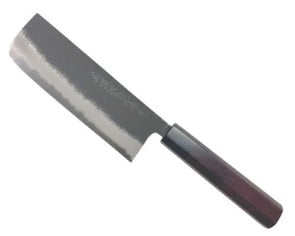
Minonokuni Raku Super Tsuchime 6.7-inch (170mm) Nakiri
Designed for precise vegetable prep, the Raku 170mm nakiri has a flat edge that push-cuts and chops without rocking, so each slice separates cleanly from the next. The thin grind and acute edge pass through onions, cabbage and roots with little effort from the cook.The hand-hammered tsuchime finish gives each blade a distinctive texture. The Aogami Super edge stays keen through a long session of vegetable prep, and the double bevel cuts straight in either hand, which makes the nakiri easier to learn than a single-bevel usuba.
Choosing a NakiriAmong our 170mm nakiri, the Homura is the low-maintenance choice with a stainless jacket, while the Aogami Black and Aogami Damascus offer kurouchi and Damascus finishes. Raku suits a cook who wants the longest-lasting edge and is comfortable with carbon steel care.The Raku 170mm santoku adds a tip for meat and fish. For katsuramuki and garnish work, a single-bevel usuba such as the Take 180mm usuba is needed. The knife shapes guide covers both. Learn More -

Minonokuni Raku Super Tsuchime 9.4-inch (240mm) Gyuto
Even for a hand-forged knife, the Raku 240mm gyuto is large. A thick spine and a thick choil taper to a very thin edge, a shape that is hard to forge by hand and that gives the knife both strength through the spine and an edge that slices cleanly.Aogami Super holds a fine edge for a long time, yet it is not hard to resharpen; it responds well to waterstones and ceramics. That combination suits a professional who preps for hours and would rather sharpen less frequently.
Comparing 240mm GyutoRaku suits a cook comfortable caring for carbon steel and sharpening on stones. A cook who wants less upkeep at this length can choose the stainless-clad Homura 240mm gyuto. The Aogami Black 240mm gyuto has a kurouchi finish, and the Aogami Damascus 240mm gyuto a Damascus pattern.For a lighter knife, the Raku 210mm gyuto is the next size down. The knife shapes guide explains how the gyuto compares with a Western chef’s knife. Learn More -

Minonokuni Raku Super Tsuchime 8.3-inch (210mm) Gyuto
The Raku 210mm gyuto is a hand-forged chef’s knife in Aogami Super, a blue steel with added alloying elements for edge retention. The 210mm length is a versatile size that covers slicing, dicing and portioning on a home board or a restaurant station.The hammered tsuchime finish leaves shallow dimples across the blade face. Combined with the knife’s profile, it gives a distinctive texture and look that varies from one piece to the next. The double bevel cuts straight in either hand.
Choosing a 210mm Blue Steel GyutoRaku suits a cook who sharpens on waterstones and wants an edge that lasts through long prep. Aogami Super is hard, so like any blue steel, it should be kept away from bones and frozen food. The Homura 210mm gyuto is the low-maintenance choice with a stainless jacket, the Aogami Black 210mm gyuto has a kurouchi finish, and the Aogami Damascus 210mm gyuto a Damascus pattern.The Raku 180mm gyuto is shorter and the Raku 240mm gyuto longer. See the kitchen knife shapes guide for the gyuto. Learn More