
You have no items in your shopping cart.
Minonokuni Knives
Authentic Japanese blades (hochoes) hand-forged using traditional Japanese methods of old-world craftsmanship; Minonokuni knives are part of a project designed to preserve and protect the master/apprentice relationship. Even as demand for Japanese knives has grown; the skilled masters are aging, and it has been difficult to keep apprentices. While the methods of construction mastered over the centuries have changed very little, the methods of bringing the pieces to market is dramatically different. Then Knife Merchant was asked to assist by bringing knives from various masters in different types of material to market, so that the craftsmen can concentrate on their work and keep the apprentice fully employed, without the burden of stopping production to make sales. Minonokuni is the name of a prefecture (state) that existed in the days of the Samurai. It encompassed a wide area including Seki-City and Sakai, which are the areas of Japan in which our craftsmen are making these blades. This is why we have chosen this as a brand name to represent these knives. You will find the quality to be far superior to comparable material types. When the knife maker has his name on the blade (instead of working for a company), there is greater pride and care taken in little details that make a great difference in final quality. Minonokuni knives are now available in a variety of grades to suit every need and price point.
-

Minonokuni Homura 8.3-inch (210mm) Gyuto
Homura puts a blue carbon steel edge inside a stainless steel jacket. Only the exposed edge needs the care a carbon knife requires, which makes this 210mm gyuto a practical way for a cook to get the edge of blue steel with far less upkeep.As the edge develops a patina with use, the blade takes on a two-tone look, with the darkened carbon edge against the matte stainless faces. The 210mm length is a versatile size for a home kitchen, long enough for slicing roasts and quick enough for dicing onions and mincing herbs.
Why HomuraAmong our double-bevel blue steel knives, Homura is the one we suggest to a cook who has not owned carbon steel before. The Aogami Black 210mm gyuto and the Aogami Damascus 210mm gyuto have iron jackets that need drying and attention, and the Raku 210mm gyuto uses a harder Aogami Super steel.The Homura 240mm gyuto adds length, and the Homura 170mm santoku is shorter. The knife shapes guide explains the gyuto.Each Homura is forged by hand, so handle colors and finish vary from piece to piece. Learn More$330.00 -
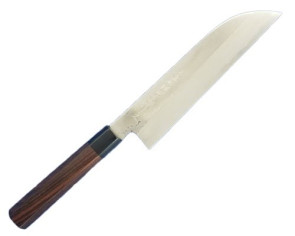
Minonokuni Sakura Damascus 8.3-inch (210mm) Kama-Usuba
The kama-usuba’s pointed, sickle-shaped tip sets it apart from the blunt-tipped Kanto usuba. This 210mm Sakura version gives the agility for decorative cuts (kazari-giri) and detailed vegetable work, along with the length for katsuramuki and long push cuts.The single-bevel edge allows very thin, clean slices that leave vegetables crisp rather than crushed. Use the flat section for sheets and julienne, and the tip for carving garnishes.
Who It SuitsSakura is a specialty line, technically more premium than Matsu, Take or Ume but not necessarily the right knife for every cook. Its blue steel core holds the edge a long time, and its thin tip is the most delicate part of the knife. It belongs with a cook experienced in single-bevel work. For a less brittle edge, compare the Take 210mm kama-usuba; for stainless, the Gin-San 210mm kama-usuba.The square-tipped Sakura Damascus 210mm usuba suits a cook who mostly cuts sheets and julienne. The knife shapes guide explains both forms. Learn More$660.00 -

Minonokuni Sakura Damascus 8.3-inch (210mm) Usuba
The Sakura Damascus usuba is a Kanto-style vegetable knife with a square tip and a long, flat edge. At 210mm, it handles long daikon for katsuramuki and whole heads of cabbage, and it slices vegetables into precise, even pieces with straight push cuts.The single bevel is what makes the paper-thin sheets of katsuramuki possible. Turn the peeled daikon against a still blade, keeping the edge parallel to the axis of the root, and a continuous sheet unrolls. Stack the sheets and push-cut them into fine threads for garnish.
Specialty LineSakura is technically more premium than our standard lines, but it is not necessarily the right usuba for every cook. Its blue steel core holds an edge for a long time, though the thin edge is delicate. Cooks newer to the usuba may prefer the Take 210mm usuba or the Ume 210mm usuba, and the plain blue steel option is the Matsu 210mm usuba.For a pointed tip, see the Sakura Damascus 210mm kama-usuba. The knife shapes guide compares the usuba with the nakiri. Learn More$660.00 -

Minonokuni Sakura Damascus 10.6-inch (270mm) Yanagi
The 270mm Sakura yanagi gives a long, even stroke for slicing sashimi from broad blocks of fish, and its Damascus jacket makes it as much a statement as a tool. The length completes each slice in one pass, which preserves texture and presentation.A long yanagi rewards a relaxed grip and an unhurried draw. Let the weight of the blade carry it through the fish and the edge do the cutting. On a deep board with room to the side, the length lets the cook set the thickness of each slice precisely.
Choosing a 270mm YanagiSakura is one of our specialty lines, technically more premium than the standard lines but not the right choice for everyone. Its blue steel core is hard and delicate, so it belongs with an experienced sushi cook. For the same length in a less brittle steel, see the Take 270mm yanagiba. For a stainless option, see the Gin-San 270mm yanagi.The Sakura 240mm yanagi is the standard counter length. Our guide to kitchen knife shapes covers the yanagi. Learn More$648.00 -

Minonokuni Sakura Damascus 9.4-inch (240mm) Yanagi
This 240mm Sakura yanagi carries the rippled Damascus pattern of the series on a traditional single-bevel slicer. It is suited to skinning and portioning fish fillets and to slicing sashimi and nigiri toppings at the standard counter length.For skinning, lay the fillet skin-side down, hold the tail end of the skin and run the blade flat between skin and flesh. For sashimi, change to a long pull from the heel. The length handles both without a change of knife.
For Experienced HandsSakura is a specialty line. It is more premium than our standard lines but not right for every cook, because its blue steel core is hard and its edge is very thin. A chef already comfortable with single-bevel knives will get the most from it. A cook still learning will be better served by the Take 240mm yanagiba.The Sakura 210mm yanagi is shorter and the Sakura 270mm yanagi longer. The plain-finish blue steel option at this length is the Matsu 240mm yanagiba. See the knife shapes guide for more on slicers. Learn More -

Minonokuni Sakura Damascus 8.3-inch (210mm) Yanagi
At 210mm, the Sakura Damascus yanagi is agile enough for home use and for chefs working with smaller blocks of fish. It is a purpose-built slicer for sushi and sashimi, with a Damascus jacket that gives each knife its own pattern.The single-bevel urasuki grind is the working part of the design. The hollow on the flat back reduces drag as the blade passes through the fish and helps each slice separate cleanly. Draw the knife from heel to tip in one long stroke, and the slice comes away with a bright, smooth face.
Sakura or a Standard Line?Sakura is a specialty line, technically more premium than Matsu, Take or Ume but not necessarily the right knife for every cook. The core is blue steel, which holds an edge longest and is also the most delicate. For a first yanagi, the Take 210mm yanagiba is less brittle; for the same steel without the Damascus finish, the Matsu 210mm yanagiba is the alternative.Longer Sakura yanagi are the 240mm and 270mm. The kitchen knife shapes guide explains the yanagi. Learn More -

Minonokuni Sakura Damascus 5.9-inch (150mm) Deba
The Sakura Damascus deba is a hand-forged, water-quenched craftsman’s piece for breaking down whole fish and splitting lobster. At 150mm, it suits small and medium fish. Its rippled Damascus jacket makes it a knife people notice on the board.Use the heel for heads and lobster shells, and the forward edge to follow the backbone for clean fillets. The single bevel keeps the edge close to the bone. As with any deba, avoid twisting the blade in a joint or using it on frozen food.
A Specialty KnifeSakura is one of our specialty lines. It is technically more premium than our standard lines, but not necessarily right for every user. The blade is blue steel, which holds an edge a long time but is delicate, and its single-bevel edge is very thin by nature. A cook new to the deba will be better served by the Take 150mm deba or the Ume 150mm deba.Search results for “Sakura knives” also turn up an unrelated company. This knife is made by Minonokuni and sold by Knife Merchant. For more on the deba, see our guide to kitchen knife shapes. Learn More -

Minonokuni Gin-San 9.4-inch (240mm) Mioroshi Deba
The 240mm mioroshi deba is a long fish knife for large fish. Its length lets the cook follow the backbone of a big salmon or yellowtail in long strokes, and its slimmer blade can then portion the fillets without switching knives.Compared with a standard deba of similar length, the mioroshi is narrower and lighter at the tip. It still handles the head and collar of large fish through the heel, but it is not a cleaver. Avoid heavy bones and frozen fish.
The Case for Gin-sanGin-san silver steel is stainless, so a long blade that spends hours around water stays free of rust with ordinary drying, and it sharpens with a feel close to carbon steel. It is a specialty line, technically more premium than our standard lines, but not necessarily the right choice for every cook.The shorter Gin-San 195mm mioroshi deba is easier to handle on medium fish. For slicing sashimi from the fillets, pair it with the Gin-San 240mm yanagi. See the knife shapes guide for the deba and yanagi. Learn More -

Minonokuni Gin-San 7.7-inch (195mm) Mioroshi Deba
At 195mm, this mioroshi deba sits between the compact 180mm and the long 240mm. It gives a little more reach along the backbone of a larger fish while staying easy to control, which makes it a sound all-round size for a kitchen that fillets fish daily.A mioroshi blends the deba and the yanagi. Its spine is heavy enough for heads and collars on medium fish, and its slimmer profile glides along the frame and can portion fillets afterward. On very large or heavy-boned fish, a standard deba is still the safer tool.
Why Stainless HereFish work keeps a blade wet, and Gin-san silver steel resists rust while sharpening much like carbon steel. As a specialty line, it is technically more premium than our standard lines, though not the right knife for every cook. A cook comfortable caring for carbon steel may be content with a standard deba from the Take line, such as the Take 195mm deba.The Gin-San 180mm mioroshi deba is shorter, and the Gin-San 240mm mioroshi deba longer. The mioroshi is described alongside the standard deba in our guide to knife shapes. Learn More -

Minonokuni Gin-San 7.1-inch (180mm) Mioroshi Deba
The mioroshi deba is longer and slimmer than a standard deba. It keeps enough weight to cut through the head and collar of a medium fish, but its narrower blade moves more easily along the frame for filleting and can take on light slicing work that would otherwise call for a yanagi.That makes the 180mm a good single knife for a cook who breaks down medium fish such as sea bream, mackerel and small salmon from start to finish. The single bevel follows the backbone closely, and the length helps take each fillet off in fewer strokes.
The Gin-san LineGin-san is our stainless single-bevel line. The silver steel sharpens with much of the feel of carbon steel but resists rust, which suits a cook who works around water all day. It is a specialty line, more premium than our standard lines, but not necessarily the right knife for everyone. A cook who wants a heavier knife for heads should look at the Gin-San 165mm deba.Longer mioroshi deba are the Gin-San 195mm and Gin-San 240mm. The knife shapes guide describes the deba and its relatives. Learn More