
You have no items in your shopping cart.
Made In Japanese Damascus Steel Knives
Made In Japanese Damascus Steel Knives
Made In’s Japanese Damascus knives are forged in Seki, Japan, a city with more than 800 years of knife making. Each blade has a VG-10 stainless steel core clad in 66 layers of Damascus steel, sharpened to a 15-degree edge. The result is a thin, light knife that makes clean, precise cuts with little effort, finished with a hand-finished handle that resists slipping and staining.
- VG-10 core, 67 layers total
- 58+ HRC
- 15° double bevel
- Full tang
- Forged in Seki, Japan
What Sets These Knives Apart
VG-10 core
A hard Japanese stainless steel that takes a keen edge and resists corrosion, so the knife stays sharp through long prep sessions.
Damascus cladding
Softer layered steel protects the hard core and gives each blade its own wave pattern.
15-degree edge
A finer angle than the 18-degree edge on Made In’s French Olive Wood knives, so the blade cuts with less resistance.
Double bevel
Sharpened on both sides, so the knives cut straight for right- and left-handed cooks alike.
Full tang
The steel runs the length of the handle for balance and control.
POM polymer handle
Hand finished, slip resistant, and stain resistant, with none of the upkeep a wood handle needs.
Choose Your Shape
Each shape suits a different cutting style. Many cooks start with a gyuto and add a nakiri for vegetables.
Gyuto
The all-purpose chef’s knife
The longest blade in the line, for slicing meat and fish, dicing onions, and mincing herbs.
- 8.2-inch blade
- Push, pull, and gentle rocking cuts
Santoku
The compact all-purpose knife
A shorter blade with a flat edge and rounded tip, easy to control for everyday prep.
- 6.6-inch blade
- Forward push cuts
Nakiri
The vegetable knife
A tall, rectangular blade with a fully flat edge for clean straight-down chopping.
- 6.6-inch blade
- Vegetables, greens, and fine julienne
Knife Sets
Matched blades at once
Buy the shapes together with the same steel, edge, and handle.
- 2-piece: gyuto and nakiri
- 3-piece: gyuto, santoku, and nakiri
Compare the Shapes
| Spec | Gyuto | Santoku | Nakiri |
|---|---|---|---|
| Blade length | 208 mm (8.2 in.) | 168 mm (6.6 in.) | 168 mm (6.6 in.) |
| Blade height | 43 mm (1 11/16 in.) | 44 mm (1.75 in.) | 48 mm (1 7/8 in.) |
| Overall length | 343 mm (13.5 in.) | 298 mm (11.75 in.) | 298 mm (11.75 in.) |
| Weight | 206 g (7.25 oz.) | 203 g (7.15 oz.) | 220 g (7.75 oz.) |
| Edge profile | Gentle curve to a point | Flat with a rounded tip | Fully flat |
| Best for | Proteins and general prep | Everyday prep in smaller kitchens | Vegetables |
Care and sharpening
- Hand wash and dry right away. Never put these knives in the dishwasher.
- Cut on wood or plastic boards. Glass, stone, and ceramic dull and can chip a hard edge.
- Hone regularly, and sharpen at 15 degrees per side to keep the factory edge.
- Avoid twisting the blade in frozen foods, bones, or hard squash rinds.
Japanese Damascus Questions
Gyuto or santoku: which should I buy first?
Choose the gyuto for its longer blade and wider range of tasks, including slicing large cuts of meat. Choose the santoku for a shorter, lighter knife that is easier to control in a small kitchen or for cooks with smaller hands.
Can left-handed cooks use these knives?
Yes. All three shapes have a double bevel, sharpened on both sides, so they cut straight in either hand.
How do these compare with Made In’s French Olive Wood knives?
The Japanese Damascus knives use harder VG-10 steel with a finer 15-degree edge for precise cuts. The Made In French Olive Wood Knives are forged in Thiers, France, from tougher X50CrMoV15 Nitro+ steel with an 18-degree edge and olive wood handles, for a sturdier, more forgiving knife such as the Made In 8-inch Forged Olive Wood Chef Knife.
Where can I compare all Made In knives?
See the Made In Knives page, and pair your knives with Made In Cookware.
Expertise provided by Knife Merchant, culinary tool specialists since 1996.
-

Made In 2-Piece Japanese Damascus Steel Knife Set
The Made In 2-Piece Japanese Damascus Steel Knife Set pairs the two blades that cover most of a home cook’s prep: the gyuto for meat, fish, and general cutting, and the nakiri for vegetables. Both are forged in Seki, Japan, with VG-10 cores inside 66 layers of Damascus steel, so they share the same sharp 15-degree edge, balance, and hand-finished handles.
What Each Knife Does8-inch gyuto: The all-purpose blade for slicing proteins, dicing onions, and mincing herbs.6.6-inch nakiri: A tall, flat-edged vegetable knife that makes clean straight-down cuts through onions, carrots, and cabbage.
Why It PerformsMatched steel and edges: Both knives share the same VG-10 core and 15-degree edge, so they cut and sharpen the same way.Two complementary shapes: The gyuto handles slicing and rocking cuts; the nakiri handles push cuts and chopping.Full tang, polymer handles: Balanced knives with handles that resist slipping and staining.
Choosing the Right Made In SetFor a third, more compact all-purpose blade, the Made In 3-Piece Japanese Damascus Steel Knife Set adds the santoku. Each knife is also sold on its own: the Made In 8-inch Japanese Damascus Steel Gyuto and the Made In 6.6-inch Japanese Damascus Steel Nakiri. Learn More -
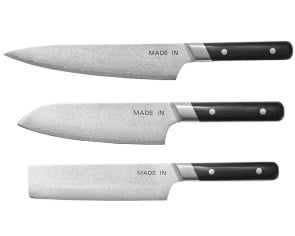
Made In 3-Piece Japanese Damascus Steel Knife Set
The Made In 3-Piece Japanese Damascus Steel Knife Set gives you the three classic Japanese kitchen shapes in one matched set. The gyuto handles slicing and general prep, the santoku is a nimble everyday blade, and the nakiri is built for vegetables. All three are forged in Seki, Japan, with VG-10 cores inside 66 layers of Damascus steel and 15-degree edges.
What Each Knife Does8-inch gyuto: The longest blade, for slicing meat and fish and for larger prep jobs.6.6-inch santoku: A compact all-purpose knife with a flat edge and rounded tip for push cuts.6.6-inch nakiri: A tall, flat vegetable knife for clean straight-down chopping.
Why It PerformsOne steel, one edge: All three share the VG-10 core and 15-degree edge, so they cut and sharpen alike.Three shapes, three cutting styles: Rocking, push cutting, and straight chopping are each covered by the shape best suited to them.Full tang, polymer handles: Balanced knives with handles that resist slipping and staining.
Choosing the Right Made In SetIf you want only a chef’s knife and a vegetable knife, the Made In 2-Piece Japanese Damascus Steel Knife Set includes the gyuto and nakiri. Each knife is also sold individually: the Made In 8-inch Japanese Damascus Steel Gyuto, the Made In 6.6-inch Japanese Damascus Steel Santoku, and the Made In 6.6-inch Japanese Damascus Steel Nakiri. Learn More -

Made In 6.6-inch Japanese Damascus Steel Nakiri
The Made In Japanese Damascus Steel Nakiri is built for vegetables. Its tall, rectangular blade and perfectly flat edge meet the cutting board along their full length, so each straight downward cut goes cleanly through an onion, a carrot, or a stack of greens without leaving connected pieces. Made In has it forged in Seki, Japan, with a VG-10 core inside 66 layers of Damascus steel.
Why It PerformsFully flat edge: Made for push cuts and straight chopping. Every cut reaches the board, so slices separate cleanly.Tall blade: The 1 7/8-inch height gives your knuckles clearance and doubles as a scoop for moving chopped vegetables to the pan.Double bevel at 15 degrees: Sharpened on both sides, so it cuts straight for both right- and left-handed cooks.VG-10 core and Damascus cladding: A hard stainless core for a long-lasting edge, protected by layered steel.Full tang, polymer handle: Balanced, with a hand-finished handle that resists slipping and staining.
What It Does BestDicing onions, carrots, and celeryShredding cabbage and slicing leafy greensThin slices of potatoes and root vegetablesFine brunoise and julienne cuts
Choosing the Right Made In KnifeThe nakiri is not designed for meat, bones, or a rocking cut. Pair it with the Made In 8-inch Japanese Damascus Steel Gyuto for proteins, or buy both in the Made In 2-Piece Japanese Damascus Steel Knife Set. For a single all-purpose blade of the same length, see the Made In 6.6-inch Japanese Damascus Steel Santoku. Learn More$199.00 -
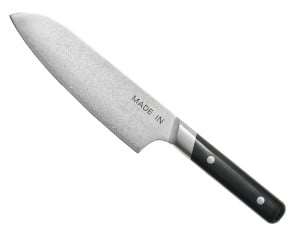
Made In 6.6-inch Japanese Damascus Steel Santoku
The Made In Japanese Damascus Steel Santoku is a compact all-purpose knife for cooks who want Japanese precision in a shorter, easier-to-control blade. Its name means “three virtues” for the three jobs it handles: slicing, dicing, and mincing. Made In has it forged in Seki, Japan, with a VG-10 core inside 66 layers of Damascus steel and a 15-degree edge.
Why It PerformsFlat edge, rounded tip: The flatter profile meets the board along its whole length, which suits a forward push cut rather than a rocking motion.Compact blade: At 6.6 inches, it is easier to control than a full chef’s knife, especially in a smaller kitchen or for cooks with smaller hands.VG-10 core and Damascus cladding: A hard stainless core for a keen, long-lasting edge, protected by layered steel with a distinctive pattern.15-degree edge: Cuts with little resistance through vegetables, boneless meat, and fish.Full tang, polymer handle: Balanced in the hand, with a hand-finished handle that resists slipping and staining.
What It Does BestDicing and slicing vegetables with a push cutSlicing boneless chicken, pork, and fishMincing herbs and garlicEveryday prep for one or two people
Choosing the Right Made In KnifeFor larger tasks and a longer slicing stroke, the Made In 8-inch Japanese Damascus Steel Gyuto gives you 8.2 inches of blade. For vegetable-heavy cooking, the Made In 6.6-inch Japanese Damascus Steel Nakiri has a taller, fully flat edge. The santoku, gyuto, and nakiri are sold together in the Made In 3-Piece Japanese Damascus Steel Knife Set. Learn More$199.00 -

Made In 8-inch Japanese Damascus Steel Gyuto
The Made In Japanese Damascus Steel Gyuto is the Japanese counterpart to a Western chef’s knife: one blade for slicing meat and fish, dicing onions, and mincing herbs. Made In has it forged in Seki, Japan, a city with more than 800 years of knife-making history, with a VG-10 core inside 66 layers of Damascus steel. The thin blade and 15-degree edge make clean, precise cuts with little effort, and the flatter profile suits a push or pull cut as well as a gentle rock.
Why It PerformsVG-10 core: A hard, stainless Japanese steel that takes a keen edge and resists corrosion, so the knife stays sharp through long prep sessions.Damascus cladding: Softer layers protect the core and give each blade its own wave pattern.15-degree edge: A finer angle than the 18-degree edge on Made In’s olive wood chef knife, so it cuts with less resistance through tomatoes, fish, and herbs.Thin, light blade: The 2.3 mm blade glides through food instead of wedging it apart.Full tang, polymer handle: Steel runs the length of the handle for balance, and the hand-finished handle resists slipping and staining.
What It Does BestSlicing proteins, from chicken breasts to raw fishDicing onions, peppers, and other vegetablesMincing herbs, garlic, and shallotsBreaking down large produce such as melons and cabbage
Choosing the Right Made In KnifeFor dedicated vegetable prep, the Made In 6.6-inch Japanese Damascus Steel Nakiri has a tall, flat blade made for straight up-and-down chopping. The Made In 6.6-inch Japanese Damascus Steel Santoku is a shorter, nimbler all-purpose blade. The gyuto is also sold in the Made In 2-Piece Japanese Damascus Steel Knife Set and the Made In 3-Piece Japanese Damascus Steel Knife Set. Cooks who prefer a heavier Western knife with a wood handle should compare the Made In 8-inch Forged Olive Wood Chef Knife, which has a sturdier 18-degree edge. Learn More$239.00

