
You have no items in your shopping cart.
Dexter Traditional Knives
Dating back to the 1800s, Dexter’s Traditional line has been trusted and adored for generations. Dexter Traditional includes Knives, Bench Scrapers, Forks and many other products. The common thread is that they feature natural wood handles affixed with brass compression rivets and made in the USA.
-

Dexter-Russell Traditional 10-inch Cook's Knife
The 10-inch Traditional cook’s knife is the long version of Dexter-Russell’s classic wood-handled chef’s knife. Its length lets one stroke cross a full cutting board, and it takes on a large roast or a winter squash with ease.Dexter rates it for everyday chopping and mincing as well as slicing. Dexter’s steel holds its edge well. The edge out of the box is fairly sharp, but the blade’s real strength is how readily it hones and sharpens. Regular honing keeps it keen, and it takes an excellent edge on whetstones, especially after a 3000-grit stone. Ten inches suits cooks with larger hands and anyone who regularly cuts in volume, from holiday cooks to caterers, and it pairs well with a carving fork at the holiday table. The blade carries no logo, which makes this knife especially good for engraving. Dexter-Russell makes it in Southbridge, Massachusetts, and the Traditional line has a loyal following in the Northeast, where generations of cooks have kept one in the drawer.
10-inch or 8-inch Traditional?The Traditional 8-inch Cook’s Knife is lighter and easier to control for everyday cooking. For a plastic handle that stands up to commercial sanitizing, the Sani-Safe 10-inch Chef’s Knife is the restaurant counterpart. Learn More$52.10 -

Dexter-Russell Traditional 6-inch Wide Boning Knife, Carbon Steel
The 1376 is one of Dexter-Russell’s longest-running patterns, a 6-inch wide boning knife with a carbon steel blade and a wood handle held by brass rivets. Its broad blade gives leverage and stability when boning out pork shoulders, beef and venison, and it is tall enough to keep the knuckles clear of the board.Dexter-Russell says the high-carbon blade takes a keen, long-lasting edge that is easy to sharpen, which is the main reason butchers and hunters still choose carbon. A few strokes on a steel bring it back during a long day of processing. Carbon steel does require more attention than stainless and will darken with use. These Traditional knives have a long following in the Northeast, close to the Southbridge, Massachusetts factory where Dexter-Russell has worked since its founding.
Other Traditional Boning KnivesThe same wide pattern comes in a 7-inch (1377) and an 8-inch (1378) length for larger animals. For tighter work around joints, the Traditional 6-inch Narrow Boning Knife (1376N) has a slimmer blade. Learn More$25.95 -
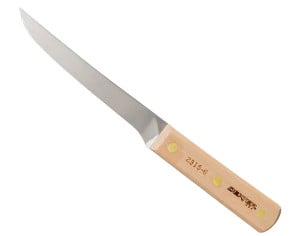
Dexter-Russell Traditional 6-inch Stiff Boning Knife, Carbon Steel
Stiff boning knives are for pressure. Separating a beef shank, splitting cartilage at a pork joint or popping a hip socket all need a blade that will not bow under the push. This 6-inch Traditional knife from Dexter-Russell has a stiff carbon steel blade for that kind of heavy boning.Because it does not flex, it is less suited to fine trimming under skin or fat, but it holds a straight line through dense tissue. Carbon steel takes an acute edge, resharpens easily and keeps that edge with regular strokes on a smooth honing rod. It will rust if left wet, so dry it after each use. The pattern is a favorite with deer hunters and small butcher shops, and Dexter’s Traditional line has an especially loyal following in the Northeast.
Stiff or Flexible?For close trimming, the Traditional 6-inch Flexible Boning Knife (1376HB) bends with the meat. A wider stiff-feeling blade is the Traditional 6-inch Wide Boning Knife (1376). Learn More$24.95 -

Dexter-Russell Traditional 6-inch Flexible Boning Knife, Carbon Steel
When the job is trimming a ham, skinning a chicken breast or following the curve of a rib cage, a flexible blade keeps more meat where it belongs. This 6-inch Traditional boning knife combines that flex with carbon steel and a wood handle, the classic Dexter-Russell build that has come out of Southbridge, Massachusetts for generations.Carbon steel takes a very sharp edge and is quick to touch up, which is why butchers and home processors who learned on it keep buying it. It does need care, since it will rust if left wet and gradually turns gray with use. These Traditional knives are especially popular with our customers in the Northeast.
Flexible or Firm?For more backbone on beef and pork, the Traditional 6-inch Stiff Boning Knife (2315-6) or the Traditional 6-inch Narrow Boning Knife (1376N) will flex less. A stain-free flexible option is the Sani-Safe 6-inch Flexible Boning Knife. Learn More$26.40 -
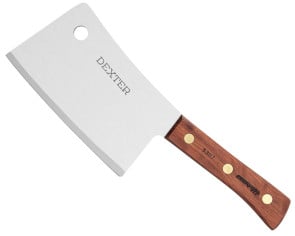
Dexter-Russell Traditional 7-inch Meat Cleaver, Carbon Steel
A meat cleaver does the work a knife should not, chopping through chicken backs, pork ribs and the thick cartilage of a beef shank. Dexter-Russell shapes the 5387 Traditional cleaver for chopping through bone and cartilage, on beef and pork bones as well as poultry.Dexter credits its carbon steel with sharpness and edge retention, and a cleaver edge in carbon is easy to restore with a file or stone. One question customers ask us is how to maintain a carbon steel cleaver. The short answer is to keep it dry and lightly oiled, and the Care section below covers the routine.
Meat Cleaver or Chinese Cleaver?Customers also ask whether to buy a meat cleaver or a Chinese cleaver. A meat cleaver is thick and heavy for bone. A Chinese chef’s knife such as the Dexter-Russell 8-inch Carbon Chinese Cleaver is thinner and meant for slicing and chopping vegetables and boneless meat, so it should be kept off bone. For a stain-free meat cleaver, see the Sani-Safe 7-inch Cleaver. Learn More$57.25 -

Dexter-Russell Traditional 8-inch Wide Boning Knife, Carbon Steel
At 8 inches, the 1378 is the longest of Dexter-Russell’s Traditional wide boning knives and the one for primals. It handles boning a whole beef chuck, taking a ham off the bone or breaking a deer hindquarter into roasts, where a shorter blade means more strokes and more ragged seams. The 8-inch blade also has the length to double as a fillet knife, and it is a popular choice for fish cutters who prefer a rigid blade, a favorite of many commercial and charter boat fishermen.Dexter-Russell credits the carbon blade with real sharpness and an edge that is easy to restore, and the long blade gives the leverage to follow a seam the full length of a large muscle. The riveted wood handle is the classic Traditional build that meat cutters have used for decades. Carbon steel needs to be dried promptly and will develop a gray patina, a trade many meat cutters accept for the way it sharpens.
8-inch or Shorter?For smaller game and pork, the 7-inch 1377 or 6-inch 1376 gives more control. A long Sani-Safe 10-inch Scimitar is the better tool for slicing boneless primals into steaks. Learn More$27.15

