
You have no items in your shopping cart.
Ceramic Waterstones
Ceramic Sharpening Stones, also known as "splash and go" stones, are a type of whetstone made from non-porous ceramic materials. Unlike traditional waterstones that require soaking before use, these stones just need to be splashed with water, making them ready for sharpening almost instantly. This feature offers a significant advantage in terms of convenience, cleanliness and efficiency. Prized for their durability, ceramic stones typically lasting longer than traditional waterstones of commensurate grits. Effective for sharpening a variety of blades, including those made from exceptionally tough steels, ceramic stones provide an excellent balance between cutting aggression and polishing power.
-

Naniwa Professional (Chosera) 1000 Grit Stone
The Professional 1000 is where a regular sharpening session starts. It takes a knife that has gone dull in use back to a clean, durable working edge, and it does so quickly enough that many cooks use it as their main stone.Naniwa makes the Professional series, sold for years as Chosera, with a magnesia bond that packs the white aluminum oxide abrasive densely. The result is a hard stone that wears slowly, stays flat and gives clear feedback through the blade. It needs no soaking; wet the surface and start.Most kitchen knives need nothing coarser than this stone unless the edge is chipped. After the 1000, a Professional 3000 refines the edge for slicing and push cuts.
Professional or Super Stone?The Advance S2 Super Stone 1000 is resin bonded and costs less. It feels softer and wears faster than the magnesia-bonded Professional, which is the harder and longer-lasting stone. Learn More$83.95 -

Naniwa Advance S2 Super Stone, 1000 Grit
The Super Stone 1000 establishes an edge on a dull knife. It is the grit most knives need most of the time, and it removes micro-pitting along the edge. Chips call for a coarser stone such as the 400.For vegetable work, the edge from this stone alone is often enough. For slicing meat and fish, continue to the Super Stone 3000 or higher for a cleaner cut.Naniwa makes the Advance S2 Super Stones with a resin bond that holds a high concentration of abrasive, so they cut quickly and need no soaking.A dull knife is ready to leave the 1000 when a burr can be felt along the whole edge on both sides. Removing that burr cleanly matters as much as raising it, so finish with light alternating strokes before moving to a finer stone.
Super Stone or Professional?The Professional 1000 is the harder, magnesia-bonded stone and stays flat longer. The Super Stone is the more economical choice with a softer feel. Our sharpening stone guide compares the stone types. Learn More$63.45 -
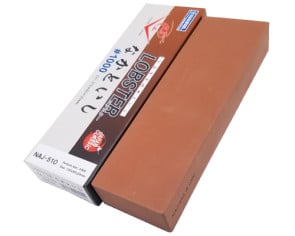
Naniwa Lobster 1000 Grit Waterstone
A 1000 grit stone is the one most sharpeners use most often, and the Lobster 1000 is Naniwa’s economical version. Use it for routine maintenance and to put an edge back on a dull knife.It is a traditional soaking stone: submerge it until the bubbles stop before sharpening. Soaking stones cut quickly and give good feedback, but they wear faster than splash-and-go stones and need regular flattening.For someone learning to sharpen, an inexpensive 1000 grit stone is a sensible place to practice holding a steady angle. Mistakes cost little, and the technique carries over directly to harder, more expensive stones. Pair it with the Lobster 3000 for a finer edge, or with the Lobster 220 for repairs. It is the stone in the Lobster line to buy first.
Upgrading laterA cook who outgrows the Lobster can move to the splash-and-go Super Stone 1000 or the harder Professional 1000. Our sharpening stone guide compares them. Learn More$27.95