
You have no items in your shopping cart.
Ceramic Waterstones
Ceramic Sharpening Stones, also known as "splash and go" stones, are a type of whetstone made from non-porous ceramic materials. Unlike traditional waterstones that require soaking before use, these stones just need to be splashed with water, making them ready for sharpening almost instantly. This feature offers a significant advantage in terms of convenience, cleanliness and efficiency. Prized for their durability, ceramic stones typically lasting longer than traditional waterstones of commensurate grits. Effective for sharpening a variety of blades, including those made from exceptionally tough steels, ceramic stones provide an excellent balance between cutting aggression and polishing power.
-

Naniwa Fine Rust Eraser
Designed to remove rust from carbon steel knives and tools. Knife Merchant Tip: Rust erasers are generally used dry, but for heavily rusted knives, adding a couple drops of tsubaki or mineral oil speeds up your work and creates a smoother finish Learn More -
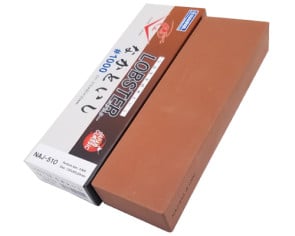
Naniwa 1000 Grit Waterstone
The Naniwa (Lobster Brand) 1000 grit waterstone is the most commonly used grit waterstone. This stone is intended for daily maintenance and establishing an edge on a dull knife. Needs to be soaked in water (usually until the bubbles stop) before use. Learn More$27.95 -

Naniwa Sharpening Stone Holder
The Naniwa Stone Holder secures your stone while sharpening or flattening. It has good traction with the rubber mounts and sufficient weight to keep from moving around. Holds stones from 5.5 to 9 inches in length.
This is good quality stainless steel that won't rust out on you. We tested one leaving it in the water overnight and pulling it out in the daytime as we used it. Other models rusted on us within days. The Naniwa never rusted after two months, and the screw downs still move smoothly. Now, these shouldn't be left in the water and we're not suggesting that. But if it gets accidentally left in the soak tank, it's not going to be a problem. Learn More$39.95 -

Naniwa Regular 220 Flattening Stone
Promotes maximum cutting for all grit sizes of whetstones. Learn More$24.95 -

Naniwa Large 24 Grit Flattening Stone
Dimensions: 11.8 in x 5.9 in x 0.8 in 24 grit Coarse carbide stone Promotes maximum cutting for all grit sizes of whetstones. Produces extremely flat results on all water stones, ceramic or traditional. Flattener and stone should be wet before use. This large flattening stone comes with rubber feet and is designed to be laid flat in a sink bottom while you hold the stone and run it across the flattener. Extra coarse for fast cutting. We use these because of the high volume of hand sharpening. This cuts quickly, but can leave fine grooves in the higher grit stones, which should be smoothed with your dressing stone. For persons doing a more normal volume of sharpening, the large 220 grit provides the benefit of truer flat without the grooving, it just takes longer. (Most flattening stones are around 220 grit) Learn More$65.00 -
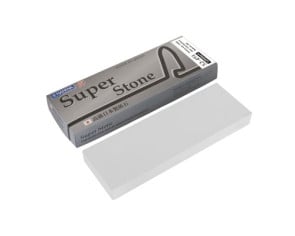
Naniwa 12,000 Grit Ceramic Super Stone
The Naniwa 12,000 Grit Super Stone is used for the final stage of sharpening. Generally speaking, a stone with this high a grit is used for polishing the shinogi line and edge of Traditional Japanese knives. Many chefs will also increase the angle a couple degrees to put a very fine micro-bevel with this stone. This stone is also very popular with straigh razor sharpeners who need to create the smoothest possible edge. This stone creates a phenomenal polish. If you're looking to create a mirror polish you'll want this stone in your arsenal. We recommend using a Naniwa dressing stone with high grit stones such as this. The dressing stone will create a slurry and clean particles that embed in these high-grit polishing stones. Learn More$107.80 -
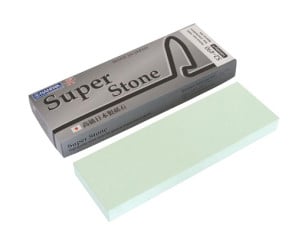
Naniwa Super Stone 10,000 Grit Ceramic Finishing Waterstone (S2-490)
Achieve the Legendary 'Scary Sharp' Mirror Edge Sharpening is a journey that begins with repair and ends with refinement. For those who demand more than just a functional edge, the Naniwa 10,000 Grit Ceramic Super Stone represents the pinnacle of Japanese abrasive technology. Unlike lower grits that remove steel to create a new edge, this ultra-fine 10,000 grit stone is a specialized tool designed to polish and temper. At this microscopic level, you are no longer 'grinding'; you are aligning the steel's molecular structure and removing the invisible burrs that prevent a knife from gliding through delicate proteins. The result is a 'mirror edge'—an aesthetic masterpiece that provides a frictionless cutting experience. Crafted using Naniwa’s proprietary resin-bonding process, this stone offers a unique tactile feedback often described as 'creamy' by professional sharpeners. This ensures you can feel the angle of your blade across the surface, providing more control than harder, glass-backed alternatives. Whether you are maintaining a high-carbon Honyaki or a modern VG-10 blade, this stone delivers the final, definitive touch of sharpness. Learn More$93.95 -

Naniwa 8000 grit Ceramic Super Stone
Size: (210x70x20 mm) (8.25x2.75x.80 in.)
The higher grit allows this stone to be used for both sharpening and polishing. However, it shouldn't be used as just a polisher. Since the grain count is higher than 6000, this waterstone will finely tune the edge of your knife allowing it to be sharpened and polished. Do not soak, just a splash and go.
Learn More$85.95 -

Naniwa 5000 grit Ceramic Super Stone
The material is made from a new resin bonding agent which allows for a higher concentration of abrasive particles. The higher abrasive levels enhance the tactile feel of the stone while improving the time of sharpening. Learn More$76.95 -

Naniwa 3000 Grit Ceramic Super Stone
Size: (210x70x20 mm) (8.25x2.75x.80 in.)
The Naniwa 3000 grit Ceramic Super Stone makes for a great final stone, a perfect step-up from the 1,000 grit stone. It is fine enough to be used prior to using a finer grit such as an 8,000 grit water stone.
The higher abrasive levels contribute to the ease of sharpening. No need to soak the stones in water, just give it a splash and go. Do not soak the stone. Learn More$72.95