
You have no items in your shopping cart.
Diamond Sharpening Rods
Keep your knives in peak cutting condition with our diamond sharpening rods. These rods feature abrasive diamond coating that quickly hones and sharpens dull edges, making them ideal for routine maintenance or prepping blades before a full sharpening session. Durable, efficient, and easy to use, diamond rods work well on a range of kitchen knives and harder steels. Whether you’re a home cook or a professional chef, find the right diamond rod to maintain sharp, reliable performance from your cutlery.
-

Victorinox 12-inch Round Solid Core Diamond Steel
The Victorinox 12-inch round solid core diamond steel is a quick way to sharpen knives on the go. At 600 grit, it is a fairly aggressive steel for removing metal and establishing an edge on a dull knife.The diamond particles are well adhered to the solid stainless rod, which makes this a product that should last for many years. We suggest a fine ceramic rod as a second tool to smooth and refine an edge sharpened on a diamond steel.Use light pressure and only a few strokes on each side. The diamond does the cutting, and heavy pressure removes more metal than the edge needs.Rinse the rod and wipe it dry after use to keep metal filings from building up on the diamond.For an oval diamond rod, see the Victorinox 12-inch Oval Diamond Sharpening Steel. For daily maintenance afterward, the Victorinox 12-inch Fine Cut Honing Steel. Our Honing Rod Guide compares diamond and honing steels. Learn More -
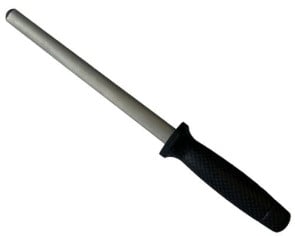
Edge World Oval Diamond Sharpening Steel
This 10 inch oval diamond sharpening rod is approximately 600 grit with the flat of the rod perpendicular to the widest part of the hand guard for safety. This Diamond sharpening steel is intended for sharpening not honing, the rod is coated with diamond dust that is course and abrasive and with a couple of passes with the edge of your knife you can restore a blunted knife to a basic edge that has a little bite and is ideal for cutting through vegetables. To find the angle you should be passing your knife along steel at think generally that a Japanese knife will have a smaller angle around 12 to 15 degrees and a German forged knife usually will be at an angle of 18 to 20 degrees. A good trick to using this diamond rod would be to first examine your knives edge and look at how thin or wide the bevel you are working with is to determine the degree of angle you hold your knife relative to the steel, if it is a wide bevel then you can work at a smaller angle, if a thin bevel then hold your knife at a higher angle closer to 20 degrees. Personally I like to lay the blade face flat against the diamond rod and then lift the spine just slighlty so I can better see the bevel touching the steel. This is an oval shaped diamond rod, the flatter oval shaped rods are made that way so the user can better hit the correct angle. In general start with a couple of passes on either side of the blade 3 to 6 passes on both sides at first, then be sure to feel along the edge for a burr starting to develop and look closely at the edge for a bevel to develop. It is important with all sharpening that the user look and feel as the sharpen to know what stage of the process they are at so they don't over or under sharpen. Learn More$19.95 -
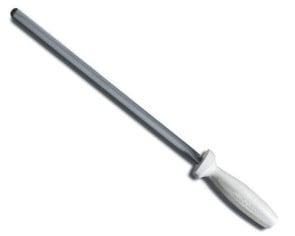
Dexter-Russell Sani-Safe 12-inch Diamond Sharpening Steel
A diamond steel does more than realign an edge. It removes a little metal, so it can bring back an edge that a smooth or regular steel no longer revives. Dexter-Russell calls the DDS-12 a diamond sharpener and intends it for routine edge maintenance between more intensive sharpenings, in professional kitchens, butcher shops and meat-processing operations.The oval shape gives the most sharpening surface area along the 12-inch length. Use a light touch, since diamond cuts faster than steel.
Diamond or Smooth Steel?For daily honing that removes almost no metal, the Sani-Safe 12-inch Smooth Butcher Steel is the gentler choice. Learn More$50.99

