
You have no items in your shopping cart.
Sharpening Steels
Sharpening Rods, also called Sharpening Steels and Honing Rods, are handheld tools used to hone or sharpen cutlery. They come in a variety of materials (mainly Steel, Ceramic and Diamond), a range of shapes (Round, Square, Oval and Flat), and varying degrees of courseness (smooth, polish, course, etc). We carry a very large selection of honing and sharpening steels and offer a breadth of information regarding the appropriate application of each tool. Please let us know if you need help selecting the proper honing steel for your cutlery or intended purpose; we are happy to offer our expertise.
-

F. Dick Fine Cut Oval Steel 10-inch
The Precision Edge: Why the F. Dick 10-Inch Fine Cut Oval Steel is a Butcher’s Essential When you are working a high-volume line or an industrial processing shift, your knife’s edge is under constant assault. The F. Dick 10-inch Fine Cut Oval Steel is not a generic sharpening rod; it is a specialized maintenance tool designed to keep high-carbon German alloys and harder Japanese steels in peak condition throughout the day. What sets this steel apart is its unique surface geometry. Unlike standard steels that feature straight vertical grooves, the F. Dick Fine Cut utilizes a series of 'S' shaped patterns. This specialized texture excels at drawing a burr away from the edge and realigning the steel at a microscopic level. The result is a smooth, polished finish that lacks the aggressive micro-serrations caused by coarser steels. Because the profile is oval rather than round, you benefit from a wider contact surface, which translates to more efficient honing with fewer strokes and better control over the blade's angle. Built for the rigors of the meatpacking and professional culinary industries, the handle is hygienically sealed to the steel. There are no gaps for food particles or bacteria to hide, making it fully compliant with strict industrial sanitation standards. The blue non-slip handle ensures a secure grip even when hands are wet or greasy, providing the stability required for safe, repetitive honing during a 12-hour shift. Made in Germany, this tool represents the pinnacle of Friedrich Dick’s centuries-old expertise in metallurgy and tool manufacturing. Learn More$73.45 -
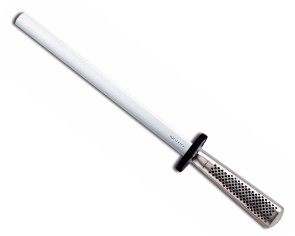
Global 10.2 in. (260mm) Oval Diamond Steel
The 10.2 inch Global Oval Diamond Steel is extremely and extremely well made sharpening rod designed to last much longer than your traditional diamond hone. This Rod has a solid core of chrome-vanadium stainless steel that is coated with up to 2 million synthetic diamond particles in a galvanic process. To enhance its resistance to abrasion the surface is additionally hard-chrome plated. This advanced process ensures the optimal recreation of a keen and long-lasting knife edge. No replacement rod needed. Learn More$219.95 -

F. Dick 10 in. Oval Diamond Steel with Non-Slip Handle
The F. Dick 10 in. Oval Diamond Sharpening Steel is 600 grit oval and solid, excellent quality. The diamond is well adhered to the steel. Oval shape provides maximum contact with the knife edge, and very few manufacturers use solid steel construction. This is a premier diamond rod on the market today most diamond rods are vastly inferior as the put a light coat of diamond dust to coat the exterior of the steel which flakes off entirely with only a couple of uses. This German made diamond rod has the diamond material ingrained in the steel and will last years instead of months. If you buy cheap Chinese diamond steels you will get poor results, by real German made products and take your edge more seriously. Made in Germany. Learn More$66.30 -
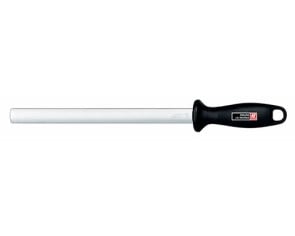
Zwilling 10 in. Oval Diamond Steel
Oval steels make better contact with knife edges than round. This diamond rod is designed to cut a new edge on your knife, as opposed to simply honing. For most users, this is a much simpler and more cost effective way to sharpen a knife than using sharpening stones. Learn More$64.95 -
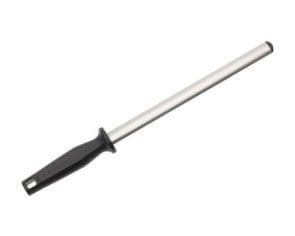
Ultimate Edge 10 in. Wide Diamond Steel (600 Grit)
The Ultimate Edge 10 in. Wide Diamond Steel (600 Grit) has a 3/4 inch oval surface that provides lots of surface contact, so fewer strokes are needed to sharpen your knife. Hollow tubing is light and saves money. There is no benefit to a solid steel with laminated with diamonds other than the heavier "feel." Made in the USA. Learn More$35.95 -
Ultimate Edge 10 in. Ultra Fine Diamond Steel
The Ultimate Edge 10 in. Ultra Fine Diamond Steel is designed as a finishing steel and not to sharpen dull knives. Using light pressure (the weight of the knife) this steel will produce a razor edge. Made in the USA Learn More$29.95 -
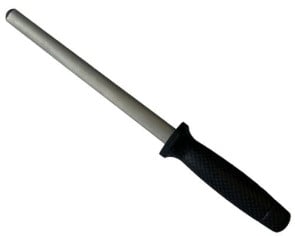
Edgeware Oval Diamond Sharpening Steel
This 10 inch oval diamond sharpening rod is approximately 600 grit with the flat of the rod perpendicular to the widest part of the hand guard for safety. This Diamond sharpening steel is intended for sharpening not honing, the rod is coated with diamond dust that is course and abrasive and with a couple of passes with the edge of your knife you can restore a blunted knife to a basic edge that has a little bite and is ideal for cutting through vegetables. To find the angle you should be passing your knife along steel at think generally that a Japanese knife will have a smaller angle around 12 to 15 degrees and a German forged knife usually will be at an angle of 18 to 20 degrees. A good trick to using this diamond rod would be to first examine your knives edge and look at how thin or wide the bevel you are working with is to determine the degree of angle you hold your knife relative to the steel, if it is a wide bevel then you can work at a smaller angle, if a thin bevel then hold your knife at a higher angle closer to 20 degrees. Personally I like to lay the blade face flat against the diamond rod and then lift the spine just slighlty so I can better see the bevel touching the steel. This is an oval shaped diamond rod, the flatter oval shaped rods are made that way so the user can better hit the correct angle. In general start with a couple of passes on either side of the blade 3 to 6 passes on both sides at first, then be sure to feel along the edge for a burr starting to develop and look closely at the edge for a bevel to develop. It is important with all sharpening that the user look and feel as the sharpen to know what stage of the process they are at so they don't over or under sharpen. Learn More$19.95

