Rocking Santoku Knives

8 Item(s)

per page

  • Global Classic 40th Anniversary 7 in. Asian Chef Knife

    Global Classic 7 in. Asian Chef Knife, much like a kiritsuki, has a nice shape and camber that makes for cutting in a rocking motion as well as push cuts. The bunka tip is also a plus as it's easy to use in a long slicing motion for celery and cutting near the root when dicing onion. Learn More
  • Miyabi Kaizen Rocking Santoku

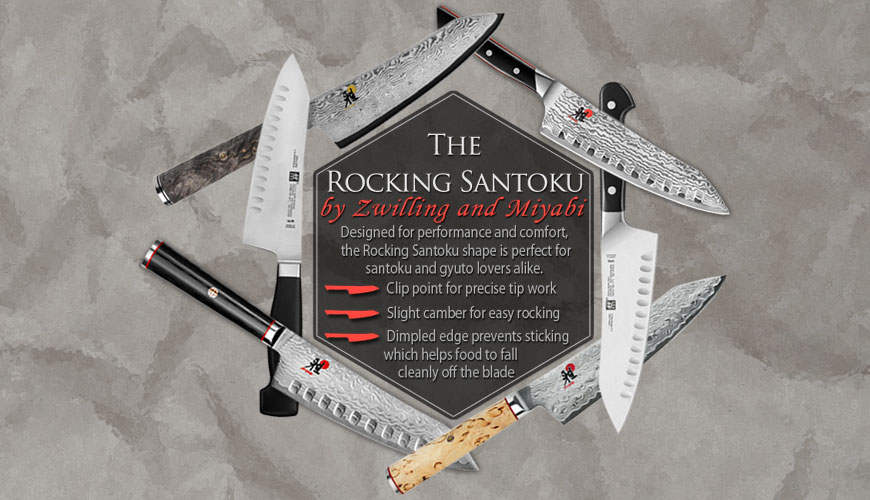
    The Miyabi Kaizen 7 in. HE Rocking Santoku features a clip point design for precise tip work, and an improved camber for a better rocking motion. The hollow edge, or dimples, on the blade's edge prevent food from sticking to the blade. Kaizen - Japanese for "improvement" or "change for the better." This line of knives combines the best hardening technology with the artistry of traditional Japanese craftsmanship. The resilient core of VG10 super steel is protected by a stunning 64-layer flower Damascus pattern.The Crydour blades feature exceptional sharpness and durability thanks to their innovative, ice-hardening treatment. Then, artisans hand-hone the blades with the historic Honbazuke method. This attention to detail translates into precision cutting for Miyabi Kaizen users. The blade is balanced by a refined D-shaped handle made of black linen Micarta. With a wood-like texture, the comfortable handle won't slip from your hand and acts as a moisture repellent. Handcrafted in Seki, Japan. Learn More
  • Miyabi Artisan SG2 Rocking Santoku Knife, 7-Inch

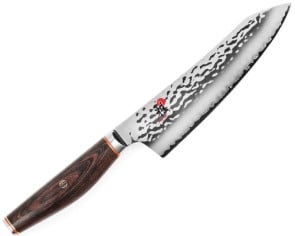
    The Intersection of Samurai Heritage and Modern Performance Effortless Rocking Motion Meets Scalpel-Like Precision In the world of high-performance Japanese cutlery, the Miyabi Artisan 7-inch Rocking Santoku stands as a masterclass in hybrid engineering. While a traditional Santoku is known for its vertical 'push-cut' motion, this 'Rocking' variant features a more pronounced belly curve. This allows you to transition seamlessly between the rhythmic rocking of a Western chef’s knife and the precise slicing of a Japanese blade. At its heart lies a core of SG2 (MC63) micro-carbide powder steel. This isn't your standard stainless; it is a high-carbon alloy with a 63 Rockwell Hardness, providing an edge that remains 'wicked sharp' long after other knives have dulled. The blade is ice-hardened using the CRYODUR process, a proprietary treatment that enhances durability and corrosion resistance without sacrificing the steel's legendary flexibility. Every inch of this blade tells a story of craftsmanship. The stunning Tsuchime finish (hand-hammered) creates small air pockets on the blade's surface, acting as a natural non-stick release for starchy potatoes or delicate cucumbers. The 'Bunka-style' clipped tip offers surgical accuracy for fine tasks like removing silver skin or mincing garlic. Completing the aesthetic and functional masterpiece is the D-shaped Cocobolo Rosewood Pakkawood handle, accented with brass and red spacers and a traditional mosaic pin. This handle is designed to nestle into the palm, reducing fatigue during long preparation sessions and providing a secure, comfortable choke grip for professional chefs and home enthusiasts alike. Learn More
  • Miyabi Evolution Rocking Santoku

    The Evolution 7 in. Rocking Santoku is an amazing knife if you like to "rock" your cuts instead of "chop". The high camber gives less stress to your wrists while cutting with a smooth rocking motion. This 7-inch hollow edge rocking santoku is perfect for all kitchen tasks and rocking cuts. Santoku - Japanese for "three virtues" - excels at three cutting techniques: expertly mince garlic, slice cucumber, and dice onions with this Asian all-rounder. The hollow edge features a blade that has small indentations, known as grantons, that prevent food from sticking while cutting. Crafted from superior quality fine carbide steel that is often used in razor blades, the knives offer the signature sharpness for which Japanese knives are known. A sophisticated six-step ice hardening technique unlocks the steel’s full potential guaranteeing these FRIODUR blades boast remarkable initial sharpness, cutting edge retention, corrosion resistance, and chip-resistant toughness. Beautifully polished to a mirror finish, the blades have a katana edge reminiscent of the samurai swords forged in the same town centuries ago. Curved for comfort and thicker at the end to prevent slipping, the triple-rivet handles encourage fatigue-free cutting. A rounded spine, heel, and bolster, plus nine hand-finishing steps ensure these handles have unsurpassed ergonomics. Learn More
  • Miyabi Black Rocking Santoku 7-inch

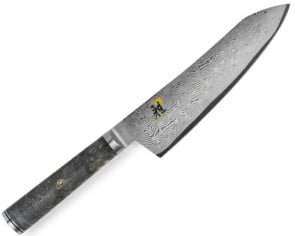
    The Apex of Japanese Metallurgy: MC66 Powder Steel The Miyabi Black Rocking Santoku is not just another kitchen tool; it is a specialized instrument designed for chefs who demand extreme edge retention. At the core of this 133-layer masterpiece is MC66 micro-carbide powdered steel (equivalent to ZDP-189), ice-hardened to a staggering 67 Rockwell Hardness (HRC). While 67 HRC typically suggests a glass-like fragility, the Miyabi Black breaks the mold. Through advanced cryo-tempering and the specific lattice structure of MC66 steel, this blade is both exceptionally hard and remarkably tough. It resists micro-chipping even during intensive dicing and chopping, ensuring it is not brittle like its competitors in the high-HRC category. The Professional Hybrid: The Rocking Santoku Traditional Santokus are known for their 'three virtues'—slicing, dicing, and mincing—but they often lack the belly required for a fluid rocking motion. This 7.1-inch hybrid model features a more pronounced curve, allowing for the rapid-fire rocking technique favored by Western professional chefs while maintaining the flat-profile dicing efficiency of a Japanese blade. The wide beveled edge is sharpened to a 9.5-12 degree angle using the three-step Honbazuke method, providing a 'scalpel-like' feel straight out of the box. Ergonomics for the 12-Hour Shift The handle is crafted from unique Black Ash, providing a natural, tactile grip that remains secure even when wet. Shaped in a traditional Japanese 'D' profile, it fits the palm's natural contours to minimize fatigue during repetitive tasks. This ergonomic focus, combined with the 193g lightweight balance, makes it the ideal workhorse for high-volume prep stations where performance cannot drop after hour eight. Learn More
  • Miyabi Birchwood Rocking Santoku

    The Miyabi Birchwood 7 in. (180mm) Rocking Santoku is a modern Japanese knife for chopping, mincing and slicing vegetables. The special feature of the Rocking Santoku is its thin blade with a kiritsuke shaped edge. Extremely versatile, can even be used for decorating purposes. This 7-inch rocking santoku is perfect for all cutting tasks, including rocking cuts. Santoku - Japanese for "three virtues" - excels at three cutting techniques: expertly mince garlic, slice cucumber, and dice onions with this Asian-style all-rounder. Handcrafted in Seki, Japan, top-of-the-line MIYABI Birchwood is a work of culinary art. Both blade and handle are crafted from the most precious materials, which shape their striking appearance. More than meets the eye, the potent core of SG2 micro-carbide powder steel is protected by a stunning 100-layer flower Damascus pattern. MIYABI’s innovative, CRYODUR ice-hardening process locks in the blade’s long-lasting sharpness. The blades are Cryodur ice-hardened for enhanced hardness, flexibility and are corrosion resistant. Each knife is hand-finished in the Honbazuke 3-step method, creating a beautiful mirror polished edge. A Katana edge is featured on each knife blade, reminiscent of the legendary Japanese swords, known for superb craftsmanship. The blade is adorned with a Birchwood traditional D-shaped style handle with an intricate mosaic pin, accented with two red spacers and stainless engraved end cap. A prized material for knife handles, Karelian Birch is also the only wood ever used in a Faberge egg. Handcrafted in Seki, Japan with a lifetime warranty. Learn More
  • Zwilling Pro 7 in. HE Rocking Santoku

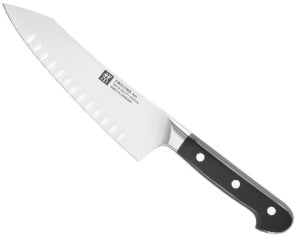
    The Best of Both Worlds, Perfected: The Zwilling Pro 7" HE Rocking Santoku Experience the ultimate fusion of Eastern design and Western ergonomics. The Zwilling Pro Rocking Santoku is a masterfully engineered hybrid, designed for the cook who loves the broad-bladed versatility of a Japanese Santoku but craves the familiar, rhythmic motion of a German chef's knife. It embodies the "three virtues" (slicing, dicing, and mincing) of a Santoku, enhanced with a curved blade that allows for effortless rocking and chopping. This knife’s innovative design is complemented by its advanced features. The blade is distinguished by its hollow edge (HE)—a series of vertical indentations, also known as a Granton edge, that create small air pockets between the blade and the food. This dramatically reduces friction and prevents starchy vegetables like potatoes and cucumbers from sticking, allowing for swift, clean, and uninterrupted prep work. This non-stick performance is built on the core of Zwilling's technology: a single piece of SIGMAFORGE steel, ice-hardened with the FRIODUR process for a relentless edge, and anchored by the revolutionary tapered bolster for unparalleled comfort and control. Learn More
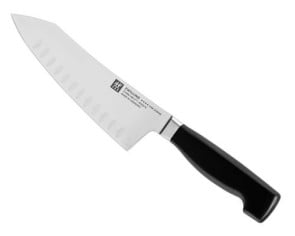
  • Zwilling Four Star 7-inch HE Rocking Santoku (1001614)

    The Zwilling Four Star 7" Rocking Santoku is designed for cooks who want the precision of a santoku and the efficiency of a Western chef’s knife. Unlike traditional santokus that have a dead flat edge, this blade features a gentle curve that creates a natural rocking motion so you can mince herbs, slice vegetables, and prep meals with ease. Thoughtfully designed for optimal performance, this blade has a clip point for precise tip work and dimples (known as a hollow-edge) that are cut just above the bevel to prevent food from sticking to the blade.  Lightweight, versatile, and easy to control, this knife is an excellent alternative to a full-size chef’s knife, especially for daily meal prep. It's also a great choice for cooks working on the line. The lightweight handle is comfortable, easy to sanitize and best of all, won't slip.  Learn More

8 Item(s)

per page