You have no items in your shopping cart.
Cutting Boards
The surface beneath a knife has a direct effect on how long its edge lasts. Glass, stone, and ceramic dull a blade quickly; wood absorbs the impact of each cut and helps a fine edge stay sharp. This collection focuses on two woods chosen for their compatibility with quality cutlery: teak and hinoki.
Teak is a dense tropical hardwood with a high natural oil content, which gives it strong resistance to moisture. Our TeakHaus boards are available in edge-grain and end-grain construction, from compact serving boards to full butcher blocks. Hinoki, a Japanese cypress, is a softer wood that gives slightly under the blade, which makes it a preferred surface for thin, hard Japanese knives. Both woods benefit from regular oiling, and board oil is available in this collection.
-

Shun Large Hinoki Board
This large cutting board from Shun is made of Japanese Hinoki, which is known for its beauty, fragrance, and longevity under the wettest conditions. Hinoki is the traditional wood of choice for building Japanese palaces, temples, shrines, and, due to its water resistance, baths. The light-colored wood features a rich, straight grain and a pleasant lemon scent. In addition to its beauty and aroma, Hinoki has an extremely tight and straight grain structure that creates the perfect cutting surface for the sharpest knives, helping to preserve their fine delicate edges. The medium soft wood combined with the straight grain structure, creates a self healing property in the board that helps to hide scratches and preserve the board's natural beauty.
Dimensions: 17 3/4 x 11 3/4 x 1 inches. Learn More$89.95 -

Shun Medium Hinoki Board
This medium sized cutting board from Shun is made of Japanese Hinoki, which is known for its beauty, fragrance, and longevity under the wettest conditions. Hinoki is the traditional wood of choice for building Japanese palaces, temples, shrines, and, due to its water resistance, baths. The light-colored wood features a rich, straight grain and a pleasant lemon scent. In addition to its beauty and aroma, Hinoki has an extremely tight and straight grain structure that creates the perfect cutting surface for the sharpest knives, helping to preserve their fine delicate edges. The medium soft wood combined with the straight grain structure, creates a self healing property in the board that helps to hide scratches and preserve the board's natural beauty.
Dimensions: 15 3/4 x 10 3/4 x 1/2 inches Learn More$54.95 -
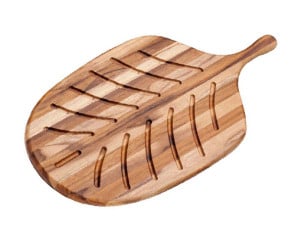
TeakHaus 19 x 9-inch Canoe Paddle Bread and Serving Board
The TeakHaus Canoe Paddle Bread and Serving Board is for hosts who slice bread at the table and want one board to slice and serve on. It is reversible: one face has canals that catch crumbs while you slice, and the other is a flat serving surface. The long paddle shape fits a baguette or a row of appetizers.
Features Bread canals: Canals on one face collect crumbs while you slice, so they stay on the board. Flat serving side: Turn the board over for cheese, charcuterie, and small plates. Paddle shape: The long, narrow board fits a baguette and carries easily by the handle. Edge-grain teak: A surface that is easy on bread knife edges. Teak’s high natural oil content acts as a moisture barrier. Thin, light build: Easy to pass around the table and store on edge.
How to Use It Slice and serve a baguette or bâtard at dinner. Line up crostini, bruschetta, or sliders on the serving side. Serve a cheese course for two to four people. Present sliced cured meats and pickles at a bar or buffet.
Choosing a Bread Board For a rectangular bread board, see the TeakHaus 16 x 11-inch Essential Bread Board. Learn More$36.00 -

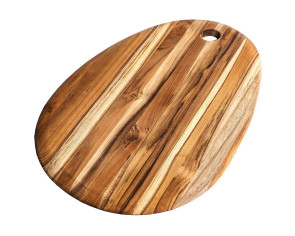
TeakHaus 16 x 11-inch Elegant Rounded Edge Serving Board
The TeakHaus Elegant Rounded Edge Serving Board is for hosts who want a thin, refined teak board that moves from prep to presentation without a change of platter. The softened edges and slim profile suit the table, and the edge-grain surface handles light cutting.
Features Edge-grain teak: A cutting surface that is easy on knife edges. Teak’s high natural oil content acts as a moisture barrier. Rounded edges: Softened corners and edges give the board a finished look for serving and a comfortable feel in hand. Thin profile: Light to carry and easy to store in a cabinet or on edge. Dual purpose: Slice on it, then serve on it.
How to Use It Serve cheese, charcuterie, and crackers. Slice and present a baguette or a loaf of bread. Cut fruit, garnishes, and herbs for light prep. Set out appetizers on a buffet or bar.
Choosing a Board For an oval serving board in the same collection, see the TeakHaus 16 x 11-inch Elegant Oval Board and the TeakHaus 18 x 12-inch Elegant Oval Board. For bread, see the TeakHaus 16 x 11-inch Essential Bread Board. Learn More$31.00 -
Rock and Branch Tennessee State Cutting and Serving Board
This beautifully crafted acacia wood cutting board is shaped in the unmistakable outline of Tennessee. The board also features a bold, laser-engraved design featuring the state name and the Tri-Star design. It's a fun way to add a bit of local "flavor" to your charcuterie platter when serving favorite meats, cheeses, fruits and breads to friends and family. The reverse side of the board is blank to use as a chopping board when prepping food. The Origins Series Board also includes a hang tie to easily double as wall art when not in use.
It's a wonderful way to show off your love of Tennessee in the kitchen, dining room, den or office. It also makes a great gift for anyone that's a fan of the state. Learn MoreRegular Price: $40.00
Special Price $30.00
-
TeakHaus 16 x 11-inch Elegant Oval Board
The TeakHaus Elegant Oval Board is a teak board for cooks who want one surface that works at the counter and on the table. At 16 by 11 inches, it suits a cheese board for a small gathering, bread service for the table, or a round of light prep work, and its slim profile keeps it easy to lift, carry, and store.
Features Naturally oil-rich teak: Teak’s high natural oil content acts as a moisture-resistant barrier, so the board resists water and staining better than many woods and stays easier to keep clean. Medium hardness: Teak is firm enough to stand up to daily use yet yields enough under the blade to help knives keep their edges longer than they would on harder surfaces such as glass or stone. Rounded oval profile: Smooth, rounded edges give the board a finished look for serving and a comfortable feel in the hand. Hanging hole: A hole at one end lets you hang the board on a hook, keeping it off the counter and out of crowded cabinets. Low maintenance: A few drops of mineral oil once a month keeps the wood conditioned.
How to Use It Cheese boards and charcuterie for two to four people Bread service with butter, oils, or spreads Appetizers and small plates Slicing fruit, herbs, and vegetables for light prep
Choosing a Size The 16 x 11-inch board is the more manageable choice for everyday use and smaller gatherings. For a fuller spread or a larger table, the TeakHaus 18 x 12-inch Elegant Oval Board offers more serving surface in the same design. Learn More$29.00 -

TeakHaus Edge Grain Teak Cutting Board - 14" x 9.5" x 0.55"
In the environment of a high-volume professional line, your cutting surface is a variable that directly dictates tool longevity. The TeakHaus 14" x 9.5" Edge Grain Cutting Board (SKU 203) is a precision-engineered interface designed specifically for those utilizing high-carbon Japanese or German alloys. While standard maple or bamboo can feel like glass under a 12-degree edge—causing micro-chipping and rapid dulling—the internal structure of teak offers a controlled, tactile compression. Weighing exactly 2.0 lbs, this board is optimized for rapid station resets and portability. During our hands-on evaluation with a 210mm Gyuto, the board exhibited a specific 'bite' that stabilizes the tip during precision draw cuts without trapping the blade. The 0.55-inch profile is not a compromise on durability; it is a calculated ergonomic choice. By lowering the work surface closer to the counter, it reduces the angle of the wrist during repetitive mincing of aromatics and shallots, mitigating fatigue during extended prep shifts. The edge grain construction ensures structural stability against the high-acid environment of citrus prep and the moisture-heavy demands of proteins. Teak’s inherent high oil content creates a natural hydrophobic barrier, preventing the deep capillary absorption that leads to warping. This board transitions seamlessly from a high-speed mirepoix station to an elegant charcuterie service, showcasing the natural chatoyancy of the teak grain that only deepens with proper mineral oil seasoning. Learn More$26.50 -

TeakHaus Edge Grain Teak Cutting and Serving Board - 12" x 8"
The Professional’s Choice for Knife-Friendly Prep and Service Harnessing the high-silica density of sustainably sourced teak to protect your finest edges while providing a lightweight, moisture-resistant surface for rapid kitchen workflows. In the hands of a professional chef, the TeakHaus 12" x 8" Edge Grain board reveals its true value through tactile feedback. Unlike standard maple or plastic surfaces that can feel 'dead' or overly resistant, the high natural oil content of this teakwood provides a subtle, cushioned 'grip' for the knife blade. This 0.55-inch slim profile isn't just about aesthetics; it’s a functional advantage for small-scale mise en place and quick-turnaround tasks where a heavy butcher block would be cumbersome. When slicing through high-moisture ingredients like citrus or tomatoes, the inherent silica levels within the teak fibers act as a natural hydrophobic barrier. We observed zero capillary action or 'wicking' of juices during heavy use, ensuring the board remains sanitary and resistant to the warping common in cheaper tropical hardwoods. The 1.5 lb weight makes the transition from the prep station to the guest's table effortless, serving as a stable canvas for artisanal cheeses or charcuterie without the wrist fatigue of traditional thick-cut boards. Every surface of this board has been hand-inspected. The edge grain construction aligns the wood fibers vertically, which specifically helps to 'catch' the impact of a rocking chef's knife or the precision tip of a paring knife, preventing the edge-rolling that occurs on harder, less forgiving surfaces. This is an essential tool for those using high-carbon German or Japanese cutlery where edge geometry is paramount. Learn More$22.50