
You have no items in your shopping cart.
F. Dick Honing Steels
For the last two hundred years, F. Dick steels have been widely recognized as the best made at world fairs and other competitions. Professional butchers likely have the best understanding of steels, or honing rods. Their work demands they start with a very sharp edge and they hone their knives every ten to fifteen minutes while working. Nearly all butchers use a polished or fine cut steel because they remove a minimum amount of metal from the edge of the knife. They will only realign the existing edge, which is what a steel is designed to do.
Our recommendation is to work with a very fine stone to rebuild your edge and a fine-cut F. Dick steel to keep it straight. When you are working as a carver / butcher, honing your knife four to six times an hour, for a full shift, you will probably want to use a Friedrich Dick polished steel in order to avoid wearing the edge down. Most cooks hone the knife before starting work or after taking it to the sharpening stone. For them, the F. Dick regular cut steel works well. If you keep the knife edge aligned, you won’t have to grind a new edge as often and the knife lasts longer.
-
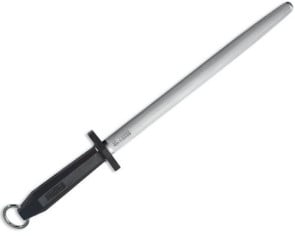
F. Dick EuroCut 12-inch Oval Fine Cut Steel
Butchers, sushi chefs and meat processors want an edge that cuts flesh without tearing, and this 12-inch EuroCut oval steel with a fine cut gives it. The edge is finer than a regular cut leaves, so slices of meat and fish come away clean.An oval face spreads contact across a wider area of the edge, which makes it easier to keep the angle steady during quick touch-ups at the board. The fine grooves remove little metal, so the rod can be used throughout a shift without wearing the knife down. The length suits slicers and breaking knives as well as chef’s knives.A light touch is all it needs.For more bite on vegetables, the EuroCut 12-inch oval regular cut steel is the sibling. A round version of this cut is the EuroCut 12-inch round fine cut steel, and a fine cut oval with a non-slip handle is the FineCut 12-inch oval steel. Learn More$43.55 -

F. Dick EuroCut 12-inch Round Fine Cut Steel
The EuroCut fine cut has lighter lines than the regular cut, so it leaves a smoother, less roughened edge. That edge slices fish and beef cleanly without tearing, which makes this 12-inch round steel a good choice for portioning and carving.Fine cut steels remove less metal and mainly straighten a rolled edge, so they suit knives that are honed regularly and kept sharp. The round profile gives precise contact along curved blades such as boning knives and scimitars. Twelve inches lets a long slicer pass the rod in one stroke.It is a good second steel beside a regular cut.For more bite on vegetables, the round regular cut sibling is the EuroCut 12-inch Round Regular Cut Steel, our best-selling steel overall. An oval version of this rod is the EuroCut 12-inch oval fine cut steel. For a finer finish still, serious professionals choose the Dickoron Micro 12-inch Oval Super Fine Cut Steel. Learn More$27.95 -

F. Dick EuroCut 12-inch Oval Regular Cut Steel
When cooks come to our store looking for a honing tool, the EuroCut 12-inch oval is the model Chef David recommends. It offers F. Dick’s regular cut on an oval rod at a working-kitchen build.The oval shape makes the honing angle more forgiving to find, and the wider face reaches the whole edge from heel to tip. Regular cut grooves straighten a rolled edge and restore bite on chef’s knives, slicers and boning knives. F. Dick tapers and balances the rod so each stroke feels the same along its length.It also fits a full-size knife roll.Our best-selling steel overall is the round version, the EuroCut 12-inch Round Regular Cut Steel. For a finer finish on meat and fish, the EuroCut 12-inch oval fine cut steel is the sibling. Cooks who want a heavier rod with a metal finger guard can compare the F. Dick 12-inch oval butcher steel. Learn More$37.70 -

F. Dick EuroCut 12-inch Round Regular Cut Steel
This is the best-selling steel in our shop. The EuroCut line puts the same F. Dick rod, with the same warranty, in a less expensive handle, so the money goes into the part that touches the knife. For American and German knives, it is the best value in a honing rod we carry.Regular cut has noticeably more texture than fine cut. That extra bite keeps a working edge on knives that see heavy daily use, and it helps on tough or waxy produce such as tomatoes and bell peppers, which a fine cut can struggle with. At 12 inches, the rod is long enough to hone a 10-inch chef’s knife or slicer in one full stroke. The round profile is the one compromise, since a round rod can roll off a counter where an oval one will not.
Regular or Fine Cut?For a gentler touch-up on knives that are already sharp, the F. Dick EuroCut 12-inch Round Fine Cut Steel has the same handle and length with less texture. If you would rather have more contact with the blade and a rod that stays put on the counter, choose the F. Dick EuroCut 12-inch Oval Regular Cut Steel. Our Honing Rod Guide explains how to match a rod to your knives. Learn More$26.65 -
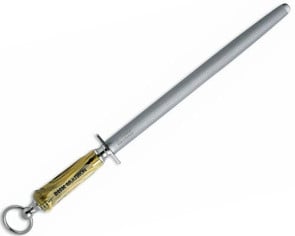
F. Dick Dickoron Multiron 12-inch Oval Steel
The Multiron combines a fine cut and a regular cut in one oval rod. Under light pressure it hones smoothly, and with more pressure slight indentations along the rod increase the abrasion to straighten damaged or burred edges.We like this steel at Knife Merchant because you can feel any problem areas on the knife as it passes. A bad spot on the edge announces itself by touch, so the cook knows where to work, and regular use on this rod lets a knife go longer between sharpenings. The cuts are fine and even for a consistent result along the 12-inch length.For a flat rod with fine and regular cuts, the F. Dick MultiCut 11-inch flat steel takes a similar approach. A single fine cut is the EuroCut 12-inch oval fine cut steel, and a finer Dickoron finish is the Dickoron Micro 12-inch Oval Super Fine Cut Steel. Learn More$123.50 -

F. Dick 10-inch Non-Chromium Polishing Steel
In meat packing plants this is simply called a butcher’s steel. It is stainless steel left unplated, because many cutters scuff the smooth surface with sandpaper until it has the texture they prefer. David leaves his smooth and uses it to burnish the edges on his protein knives.A smooth rod is the right match for stamped butcher knives from Victorinox and Dexter-Russell. Their steel runs soft, around 54 to 56 Rockwell, and comes back sharp on a polishing rod alone. On steel this soft, a textured rod is more than the edge needs. A smooth rod is also the standard for poultry and seafood processing, where the cleanest possible edge matters. Any tearing at the cellular level is the first thing to discolor on delicate proteins. A knife such as the Victorinox Fibrox Pro 5-inch Curved Semi-Stiff Boning Knife is exactly what this steel is for.
Smooth or Fine Cut?For harder German and American knives that need a little bite, choose the F. Dick 10-inch Round Fine Cut Sharpening Steel, Red Handle. The F. Dick Poliron 10-inch Polish Steel with Non-Slip Handle is another smooth steel, with a non-slip handle. Our Honing Rod Guide matches rod textures to steel hardness. Learn More$31.20 -

F. Dick Poliron 10-inch Oval Polished Steel with Non-Slip Handle
Butchers and meat processors who want the smoothest edge a honing rod can give reach for a polished steel such as the Poliron. A smooth edge cuts meat without tearing, which helps keep portions even and yields high.A polished surface removes no metal. It straightens the edge and polishes it, so it can follow a coarser steel to refine an edge that a regular or fine cut has roughened. Slim edges tend to fold over before they actually go dull, and a few strokes on the Poliron set them upright again. The oval face makes the angle easy to hold.To pair it with a coarser rod, the 10-inch round regular cut steel with non-slip handle shares the handle style. A square rod with polished and fine faces is the F. Dick 10-inch square polished and fine cut steel, and a Dickoron polished rod is the Dickoron Polish 12-inch oval steel. Learn More$79.30 -

F. Dick FineCut 10-inch Oval Steel with Non-Slip Handle
Rather than straight grooves, the FineCut pattern resembles a series of S shapes. It removes a burr and smooths the edge without leaving micro-serrations, and it works well on German knives and on Japanese knives too.A 10-inch rod is short enough to carry in a scabbard and long enough for most kitchen knives, including chef’s knives and breaking knives up to 10 inches. The oval face gives more contact than a round rod, so the edge comes back in fewer strokes. Because it is a fine cut, it maintains an edge rather than repairing a damaged one.It also suits a scabbard on the belt.A 12-inch version is the FineCut 12-inch oval steel. When the edge needs more correction, a regular cut such as the 10-inch round steel with non-slip handle takes it further. A red-handled round fine cut is the F. Dick 10-inch round fine cut steel. Learn More$73.45 -

F. Dick 10-inch Square Polished and Fine Cut Combination Steel
Four faces give this 10-inch F. Dick combination steel two finishes in one rod, with two polished sides and two fine cut sides. Butchers and meat processors who need to work efficiently can choose the edge for the job without reaching for a second steel.A polished edge is very smooth and suits cutting proteins into even portions. The fine cut sides leave a slightly rougher edge with a little bite, which helps when slicing tomatoes and other fruit and vegetables. The flat faces of the square rod also make it easy to see and hold the angle.It also suits a crowded knife roll.For more correction, the F. Dick 10-inch square regular and fine cut steel pairs a regular cut with a fine cut. A Dickoron version with sapphire and polished faces is the Dickoron Combi 12-inch square steel. A single polished rod is the Poliron 10-inch oval steel. Learn More$77.35 -

F. Dick FineCut 12-inch Oval Steel with Non-Slip Handle
The FineCut surface looks different from most steels, with grooves shaped like a run of S curves rather than straight lines. It removes a burr and smooths the edge without leaving micro-serrations, so it is recommended for Japanese knives as well as German ones.At 12 inches, the rod gives long slicers and 10-inch chef’s knives a full stroke from heel to tip. The oval profile presents a wide face that makes the angle easier to hold. A rod that actually straightens the edge and holds up under heavy use is what keeps a busy kitchen cutting cleanly between sharpenings.For a cook with both German and Japanese knives, one fine cut rod can look after the whole roll.A shorter version is the FineCut 10-inch oval steel, and a round profile is the FineCut 12-inch round steel. For more bite, the 12-inch oval regular cut steel with non-slip handle has the same shape. Learn More$74.10

