
You have no items in your shopping cart.
Best Sellers
-
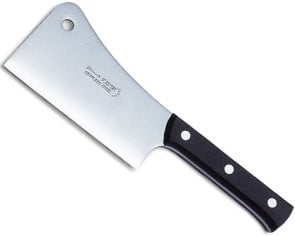
F. Dick 7-inch 2-Pound Meat Cleaver
Chops, ribs and restaurant butchering are the jobs for this 2-pound F. Dick cleaver. It has enough weight to sever meat and bone in a clean stroke and a long, thick handle that balances the heavy blade.The forged blade is tapered so it wedges through bone instead of bouncing off it. The bolster is smoothed, so it does not dig into the hand during heavy use, and a hole in the blade lets the cleaver hang on a hook or rail. Each edge is hand-sharpened at the F. Dick factory.Restaurant kitchens that cut their own short ribs and oxtails get a cleaver heavy enough for bone that still lifts easily for repeated strokes. The 7-inch blade also leaves room to scoop cut pieces off the block.A lighter option for poultry is the 6-inch 1-pound meat cleaver. For beef and larger pork bones, the 9-inch 3-pound and 10-inch 4-pound cleavers bring more mass. The comparison table below shows each weight and its typical work. Learn More$76.70 -
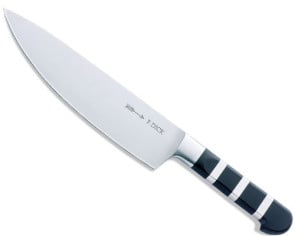
F. Dick 1905 8-inch Chef’s Knife
An 8-inch chef’s knife handles most of the cutting in a kitchen, and the 1905 version covers the full range, from breaking down a chicken and slicing meat to dicing onions and cutting a fine julienne. Its gently curved edge and upswept tip suit cooks who like a rocking motion. For the price, it is one of the finest chef’s knives available.The knife balances well in the hand, and the shape of the bolster leaves room for a pinch grip, where the thumb and forefinger hold the blade itself for extra control. The look of the series goes back to a 1905 F. Dick design with solid collars on the handle.For smaller hands or a small board, the 1905 6-inch chef’s knife is easier to manage, and the 1905 10-inch chef’s knife moves more food per stroke. Cooks who prefer push cuts can compare the 1905 7-inch granton edge santoku. A Premier Plus 8-inch chef’s knife offers a more modern handle at the same length. Learn More$107.25 -
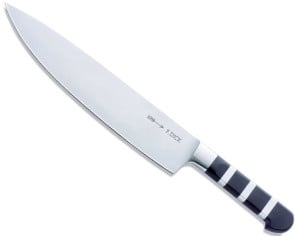
F. Dick 1905 10-inch Chef’s Knife
Professional cooks in high-volume kitchens buy this 10-inch 1905 chef’s knife to prep large amounts of vegetables without tiring their hand. The longer blade fits more food under it with each stroke and reaches across a whole cabbage or a large melon.A long, heavy blade can feel tip-heavy, and this one keeps good balance for its size, which makes it comfortable through a long prep list. The series responds well to regular honing, so a few strokes on a steel at the start of each shift keep the edge working.The long blade also slices roasts and large fish fillets neatly.If 10 inches feels like too much knife, the 1905 8-inch chef’s knife is the all-round size. For heavy portioning of meat, the 1905 AJAX butcher’s chef’s knife carries more weight. The Premier Plus 10-inch chef’s knife is the same length with a modern handle. Our kitchen knife shapes guide covers chef’s knife lengths. Learn More$128.05 -

F. Dick Premier Plus 8-inch Chef’s Knife
Cooks reach for an 8-inch chef’s knife for almost every task in the kitchen, so comfort over long periods matters as much as the edge. The Premier Plus 8-inch is well balanced, and that balance is what you notice first when you use it for an hour of prep. In our view, no better chef’s knife is made in Germany than the Premier Plus.The bolster is smoothed where the thumb and forefinger rest, so a choke grip on the blade stays comfortable. The curved edge rocks through herbs and onions, and the tip handles finer work such as scoring and trimming. The steel gives a lasting edge and still hones back quickly on a steel.It is also the knife to choose first when building a kit.For cooks with smaller hands, the Premier Plus 6-inch chef’s knife is easier to control, and taller cooks may prefer the 9-inch or 10-inch versions. The 1905 8-inch chef’s knife has a classic ringed handle at the same length. Our knife shapes guide covers chef’s knives. Learn More$97.50 -
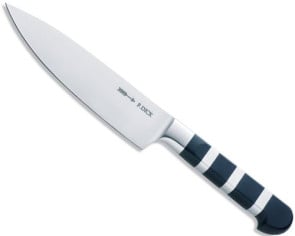
F. Dick 1905 6-inch Chef’s Knife
A 6-inch chef’s knife suits cooks with smaller hands, small cutting boards and quick jobs such as slicing a shallot or a few cloves of garlic. This 1905 version stays sharp and has a comfortable handle that does not cramp the hand through long use.The shorter blade gives more control near the tip, which helps with fine dicing and with work close to the hand. It still has enough height for chopping herbs and enough length to slice a chicken breast. The 1905 knives are easy to hone and resharpen, so the edge is simple to keep in shape at home.It also fits easily in a knife roll or a small drawer, which makes it a good travel knife for a vacation rental kitchen.For bigger produce and longer slicing, the 1905 8-inch chef’s knife is the standard size. A 1905 6-inch utility knife is narrower at the same length, and the 1905 herb knife is built for mincing. Learn More$92.95 -

Mercer Genesis 8-inch Short Bolster Chef’s Knife
The 8-inch Genesis chef’s knife is the forged Mercer knife for cooks who want the weight and balance of a German-style blade with a soft, non-slip handle. Mercer shortens the bolster on this model, so the edge runs all the way to the heel and the whole blade can be sharpened, a detail that matters after a few years of honing and sharpening.The Santoprene handle grips securely even when the hand is wet or greasy, which suits a busy professional station as well as a home kitchen. The blade has enough curve to rock through herbs and garlic and enough length to dice an onion or break down a chicken.
Choosing a Size and LineFor more reach, see the Genesis 9-inch and 10-inch Short Bolster Chef’s Knives. The Renaissance 8-inch Chef’s Knife is the forged alternative with a riveted handle, and the Millennia 8-inch Chef’s Knife is the lighter stamped option. Our kitchen knife shapes guide explains how chef’s knife lengths compare. Learn More$56.70 -

Mercer Renaissance 8-inch Chef’s Knife
The Renaissance 8-inch Chef’s Knife is Mercer’s forged knife with a traditional look: a triple-riveted Delrin handle and a full tang running through it. For a home cook who wants the build of a German forged knife without a premium-brand price, or a student assembling a first serious kit, it is a straightforward choice.Mercer shortens the bolster on the Renaissance line, so the edge runs to the heel and the whole blade can be sharpened. The 8-inch length dices onions, slices proteins and rocks through herbs, and it is the size most cutting boards and knife rolls are built around.
Renaissance or Genesis?Both lines are forged from the same high-carbon German steel at the same hardness. The difference is the handle. The Genesis 8-inch has a soft Santoprene grip that holds when wet; the Renaissance has a harder riveted handle with a classic shape. For more reach, see the Renaissance 9-inch and 10-inch Chef’s Knives. Learn More$71.20 -
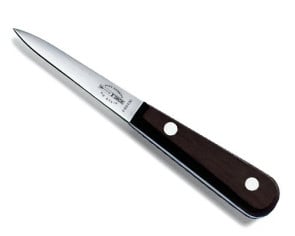
F. Dick 3-inch Oyster Knife
Small, delicate oysters with wavy shells, such as Kumamotos, Olympias and Belons, need a precise knife, and this 3-inch F. Dick oyster knife has a pointed tip and a sharpened edge to find the hinge and cut the adductor muscle cleanly.Most oyster knives have a blunt blade, which can crush a fragile shell. This one has an edge ground into it, so it also opens clams, which need to be cut rather than pried. The pointed tip slips into a tight hinge with little force, and the short blade gives control close to the hand.At a raw bar, a dedicated knife for small oysters also speeds up service. It keeps the presentation neat on the half shell.For larger, heavier oysters, the F. Dick 2.25-inch stainless steel oyster shucker is the counterpart. Protect the hand holding the shell with a folded towel or a cut-resistant glove. Our knife shapes guide covers oyster and clam knives. Learn More$28.60 -

F. Dick Premier Plus 3.5-inch Paring Knife
The Premier Plus paring knife is small and sharp, made for peeling, small cutting jobs and decorating. Its 3.5-inch blade is the size cooks use in the hand for coring and trimming.Paring work happens close to the fingers, so control matters more than length. The short, forged blade stays rigid when it is pushed into a tough apple core or the stem of a tomato. F. Dick has been forging kitchen knives since the 1800s, and this small knife carries the same construction as the larger Premier Plus blades.A paring knife also finishes small tasks at the stove, such as scoring a sausage or cutting a lemon for a final squeeze. Keep one near the range so the chef’s knife stays at the board.A blue-handled version suits color-coded kitchens, and the Premier Plus 4.5-inch paring knife adds reach for grapefruit and small slicing. For tourné cuts, the Premier Plus bird’s beak peeler is the better shape. Learn More$47.45 -

F. Dick 1905 3.5-inch Paring Knife
Peeling, slicing and garnishing fruits and vegetables are the jobs for this 3.5-inch 1905 paring knife. It comes with a keen edge that cuts thin, even tomato slices for a knife this small.A paring knife does much of its work in the hand, and the short blade keeps the tip close to the fingers for control when hulling strawberries or coring tomatoes. The ringed 1905 handle gives a secure grip for that close work.A paring knife also handles small jobs at the stove, such as scoring the skin of a sausage, testing a potato for doneness or cutting a lemon to finish a dish. Keep one near the range so the chef’s knife stays on the board.For tourné cuts and peeling round produce, the curved 1905 3-inch bird’s beak peeler is better shaped. Larger fruit and slicing on the board suit the 1905 6-inch utility knife. The comparison table below lists the 1905 paring and utility knives. Learn More$49.40

