
You have no items in your shopping cart.
Best Sellers
-

F. Dick Premier Plus 3.5-inch Paring Knife
The Premier Plus paring knife is small and sharp, made for peeling, small cutting jobs and decorating. Its 3.5-inch blade is the size cooks use in the hand for coring and trimming.Paring work happens close to the fingers, so control matters more than length. The short, forged blade stays rigid when it is pushed into a tough apple core or the stem of a tomato. F. Dick has been forging kitchen knives since the 1800s, and this small knife carries the same construction as the larger Premier Plus blades.A paring knife also finishes small tasks at the stove, such as scoring a sausage or cutting a lemon for a final squeeze. Keep one near the range so the chef’s knife stays at the board.A blue-handled version suits color-coded kitchens, and the Premier Plus 4.5-inch paring knife adds reach for grapefruit and small slicing. For tourné cuts, the Premier Plus bird’s beak peeler is the better shape. Learn More$47.45 -

F. Dick 1905 3.5-inch Paring Knife
Peeling, slicing and garnishing fruits and vegetables are the jobs for this 3.5-inch 1905 paring knife. It comes with a keen edge that cuts thin, even tomato slices for a knife this small.A paring knife does much of its work in the hand, and the short blade keeps the tip close to the fingers for control when hulling strawberries or coring tomatoes. The ringed 1905 handle gives a secure grip for that close work.A paring knife also handles small jobs at the stove, such as scoring the skin of a sausage, testing a potato for doneness or cutting a lemon to finish a dish. Keep one near the range so the chef’s knife stays on the board.For tourné cuts and peeling round produce, the curved 1905 3-inch bird’s beak peeler is better shaped. Larger fruit and slicing on the board suit the 1905 6-inch utility knife. The comparison table below lists the 1905 paring and utility knives. Learn More$49.40 -

MAC Chef Series 2.5-inch Bird’s Beak Paring Knife
A bird’s beak parer, also called a tourné knife, has a blade that curves down toward the tip, and the PK-25 is MAC’s version in the thin Chef Series. Cooks trained in classic French technique use it to turn potatoes and carrots into seven-sided tourné cuts; at home it is the knife for peeling apples, coring strawberries and trimming the eyes from potatoes.The curve follows the shape of round fruit and vegetables, so the edge stays in contact as you rotate the food against your thumb. It is also handy for deveining shrimp and scoring citrus peel. For board work such as slicing shallots, a straight parer like the HB-40 is easier to use. Our guide to kitchen knife shapes describes the paring knife family. Learn More$37.95 -

MAC Original 4-inch Paring Knife
The Mac Original 4-inch Paring Knife was designed with comfort in mind. Use this paring knife when peeling, paring or slicing small fruits and vegetables, and you will find that the up-swept handle fits comfortably into your hand. A hole near the rounded tip makes it easy to hang.The rounded tip is a safety feature of the Original Series, and it makes the knife a good choice for a kitchen with several cooks or for anyone who carries a parer loose in a drawer. It is less suited to jobs that need a point, such as coring tomatoes or scoring; the Chef Series HB-40 has a pointed tip for those.The PK-40 is also part of the 2-piece and 3-piece Original sets. Our Kitchen Knife Shapes guide covers the paring knife and its variations. Learn More$33.95 -
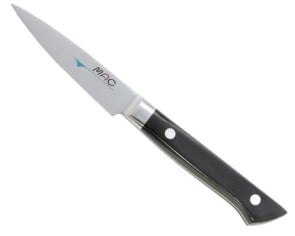
MAC Professional 3.25-inch Paring Knife
The PKF-30 is the shortest knife in the MAC Professional Series, a 3.25-inch parer with a bolster. The short, pointed blade gives close control for in-hand work such as hulling strawberries, peeling shallots and trimming Brussels sprouts, and the bolster gives the fingers a solid stop.Because the blade is short, the hand sits near the tip, which makes it the right parer for fine, careful cuts: segmenting citrus, removing seeds from chiles and scoring the skin of tomatoes before blanching. For slicing small items on the board, a longer parer such as the Chef Series HB-40 or the 5-inch PKF-50 gives more edge to work with.Compare the parers in the table in the Details, or see our Kitchen Knife Shapes guide. Learn More$64.95 -

Mercer Genesis 3.5-inch Paring Knife
The Genesis 3.5-inch Paring Knife handles the small jobs: peeling, coring, deveining shrimp, scoring citrus and trimming garnishes. It is forged, so it has more weight and balance than a stamped parer, and the bolster keeps the fingers from sliding onto the edge.The Santoprene handle grips securely when wet, which matters on a slick apple or a juicy tomato.
Choosing a Paring KnifeFor a riveted handle, see the Renaissance 3.5-inch Paring Knife. The Millennia 3.5-inch Paring Knife is lighter. For peeling round produce, the Genesis 2.5-inch Bird’s Beak Peeler follows the curve. The kitchen knife shapes guide covers paring knives. Learn More$26.55 -

Dexter-Russell Traditional 3.25-inch Paring Knife, Carbon Steel
Dexter-Russell’s Traditional 3.25-inch paring knife is the small companion to its classic wood-handled cook’s knives, and shoppers find it by its item number, 15271. Dexter recommends it for peeling fruits and vegetables, cutting cheese and other basic prep.The blade takes a very fine edge and comes back quickly on a honing steel or a fine stone. It develops a gray patina with use and must be dried after washing, so it suits cooks who enjoy looking after their knives. In the hand it is light and nimble, good for hulling strawberries or coring tomatoes, and a handy knife to keep beside the sink for quick jobs. Dexter builds it in Southbridge, Massachusetts, and the Traditional line has long had a following in Northeast kitchens.
A Stain-Free AlternativeFor a parer that needs no special drying, the Sani-Safe 3.25-inch Cook’s Style Paring Knife has the same blade length, and the V-Lo 3.5-inch Paring Knife adds a cushioned grip. Learn More$12.45 -

Victorinox Hardwood 4.75-inch Paring and Utility Knife
When a 3.25-inch paring knife feels too small and a 6-inch utility knife too large, this 4.75-inch Victorinox knife fills the gap. The extra length gives the leverage for clean, single-pass cuts while staying small enough for work in the hand.Use it for deveining shrimp, segmenting citrus and trimming silver skin from a tenderloin, or for halving cherry tomatoes and slicing a shallot on the board. The straight edge and fine point make it a good detail knife for a prep station.Its wood handle is from the line Victorinox called Rosewood for many years and now calls Victorinox Hardwood. The handle is modified maple in the traditional rosewood color.For a serrated version, see the Hardwood 4.75-inch Wavy Edge Utility Knife. A longer blade for sandwiches and cheese is the Hardwood 6-inch Utility Knife, and the Hardwood 3.25-inch Paring Knife is the classic parer. The table in the Details compares these sizes. Learn More$44.00 -

Victorinox Swiss Classic 3.25-inch Sheep’s Foot Paring Knife, Red Handle
The Victorinox 3.25-inch red sheep’s foot paring knife is also called a vegetable knife, a straight paring knife or a kudamono paring knife. The flat bottom of the blade makes it a strong choice for trimming or peeling produce and chilies.Because the edge is straight from heel to tip, it meets the cutting board along its whole length. Slices of radish or strawberry come out even, and there is no sharp point to slip when you trim the stem from a pepper.The red handle is easy to spot on a busy counter and suits a kitchen that color-codes its tools. Draw the edge toward your thumb for peeling, and use a forward push on the board.The same knife with a black handle is the Swiss Classic 3.25-inch Sheep’s Foot Paring Knife, Black Handle. For a serrated sheep’s foot, see the red serrated sheep’s foot parer. Our Kitchen Knife Shapes guide explains paring knife shapes. Learn More -
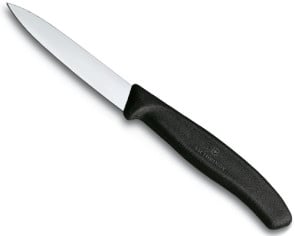
Victorinox Swiss Classic 3.25-inch Spear Point Paring Knife, Black Handle
The 3.25-inch spear point parer is the basic Victorinox paring knife, and this one has a black Swiss Classic handle. Its pointed tip handles work in the hand, such as peeling, coring and hulling, and small jobs on the board, such as mincing a shallot or a clove of garlic.The blade tapers to a fine point that pierces skins and lifts out seeds accurately. The light, textured handle fits large and small hands and stays secure when it is wet.Hold the fruit in one hand and draw the blade toward your thumb in short, controlled strokes. On the board, use the tip for fine cuts and keep the edge flat for slicing.The same knife comes with a red or a white handle. For a straight edge and no point, see the Swiss Classic 3.25-inch Sheep’s Foot Paring Knife, and for a little more length, the 4-inch black parer. Our Kitchen Knife Shapes guide explains paring knife shapes. Learn More

