
You have no items in your shopping cart.
Best Sellers
-
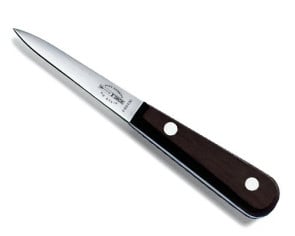
F. Dick 3-inch Oyster Knife
Small, delicate oysters with wavy shells, such as Kumamotos, Olympias and Belons, need a precise knife, and this 3-inch F. Dick oyster knife has a pointed tip and a sharpened edge to find the hinge and cut the adductor muscle cleanly.Most oyster knives have a blunt blade, which can crush a fragile shell. This one has an edge ground into it, so it also opens clams, which need to be cut rather than pried. The pointed tip slips into a tight hinge with little force, and the short blade gives control close to the hand.At a raw bar, a dedicated knife for small oysters also speeds up service. It keeps the presentation neat on the half shell.For larger, heavier oysters, the F. Dick 2.25-inch stainless steel oyster shucker is the counterpart. Protect the hand holding the shell with a folded towel or a cut-resistant glove. Our knife shapes guide covers oyster and clam knives. Learn More$28.60 -

F. Dick Premier Plus 3.5-inch Paring Knife
The Premier Plus paring knife is small and sharp, made for peeling, small cutting jobs and decorating. Its 3.5-inch blade is the size cooks use in the hand for coring and trimming.Paring work happens close to the fingers, so control matters more than length. The short, forged blade stays rigid when it is pushed into a tough apple core or the stem of a tomato. F. Dick has been forging kitchen knives since the 1800s, and this small knife carries the same construction as the larger Premier Plus blades.A paring knife also finishes small tasks at the stove, such as scoring a sausage or cutting a lemon for a final squeeze. Keep one near the range so the chef’s knife stays at the board.A blue-handled version suits color-coded kitchens, and the Premier Plus 4.5-inch paring knife adds reach for grapefruit and small slicing. For tourné cuts, the Premier Plus bird’s beak peeler is the better shape. Learn More$47.45 -

F. Dick 1905 3.5-inch Paring Knife
Peeling, slicing and garnishing fruits and vegetables are the jobs for this 3.5-inch 1905 paring knife. It comes with a keen edge that cuts thin, even tomato slices for a knife this small.A paring knife does much of its work in the hand, and the short blade keeps the tip close to the fingers for control when hulling strawberries or coring tomatoes. The ringed 1905 handle gives a secure grip for that close work.A paring knife also handles small jobs at the stove, such as scoring the skin of a sausage, testing a potato for doneness or cutting a lemon to finish a dish. Keep one near the range so the chef’s knife stays on the board.For tourné cuts and peeling round produce, the curved 1905 3-inch bird’s beak peeler is better shaped. Larger fruit and slicing on the board suit the 1905 6-inch utility knife. The comparison table below lists the 1905 paring and utility knives. Learn More$49.40 -

Mercer Genesis 3.5-inch Paring Knife
The Genesis 3.5-inch Paring Knife handles the small jobs: peeling, coring, deveining shrimp, scoring citrus and trimming garnishes. It is forged, so it has more weight and balance than a stamped parer, and the bolster keeps the fingers from sliding onto the edge.The Santoprene handle grips securely when wet, which matters on a slick apple or a juicy tomato.
Choosing a Paring KnifeFor a riveted handle, see the Renaissance 3.5-inch Paring Knife. The Millennia 3.5-inch Paring Knife is lighter. For peeling round produce, the Genesis 2.5-inch Bird’s Beak Peeler follows the curve. The kitchen knife shapes guide covers paring knives. Learn More$26.55

